

search
0
Category

Inside Modern Data Teams

Is the Data Warehouse Dead?

From Data Warehouse to Data Platform

Every few years, a new buzzword hits the data industry — and suddenly, the tools and methods we’ve relied on for decades are declared obsolete. Today, that target seems to be the data warehouse. Blogs and conferences proclaim its death, replaced by the data lake, data lakehouse, or even the elusive “data mesh.” But is the data warehouse really dead? Or has it simply evolved into something new?


The “Death” of the Data Warehouse: Where It All Began

For years, the data warehouse has been the foundation of enterprise analytics. It provided a structured, trusted, and governed environment where business data could be collected, cleansed, and analyzed. However, as data volumes exploded and new types of unstructured data emerged, traditional warehouses started showing their age.

Slow ETL processes, rigid schemas, and scalability issues led many to look for alternatives. Enter the data lake — a more flexible, schema-on-read environment that could store raw, unstructured data cheaply and at scale. Suddenly, the industry narrative shifted: data lakes were the future, and warehouses were history.

But as many organizations soon learned, simply dumping everything into a lake didn’t magically solve all their problems. Without governance, context, and structure, data lakes quickly turned into data swamps — massive pools of untrustworthy, undocumented information. And that’s when the story started to change again.
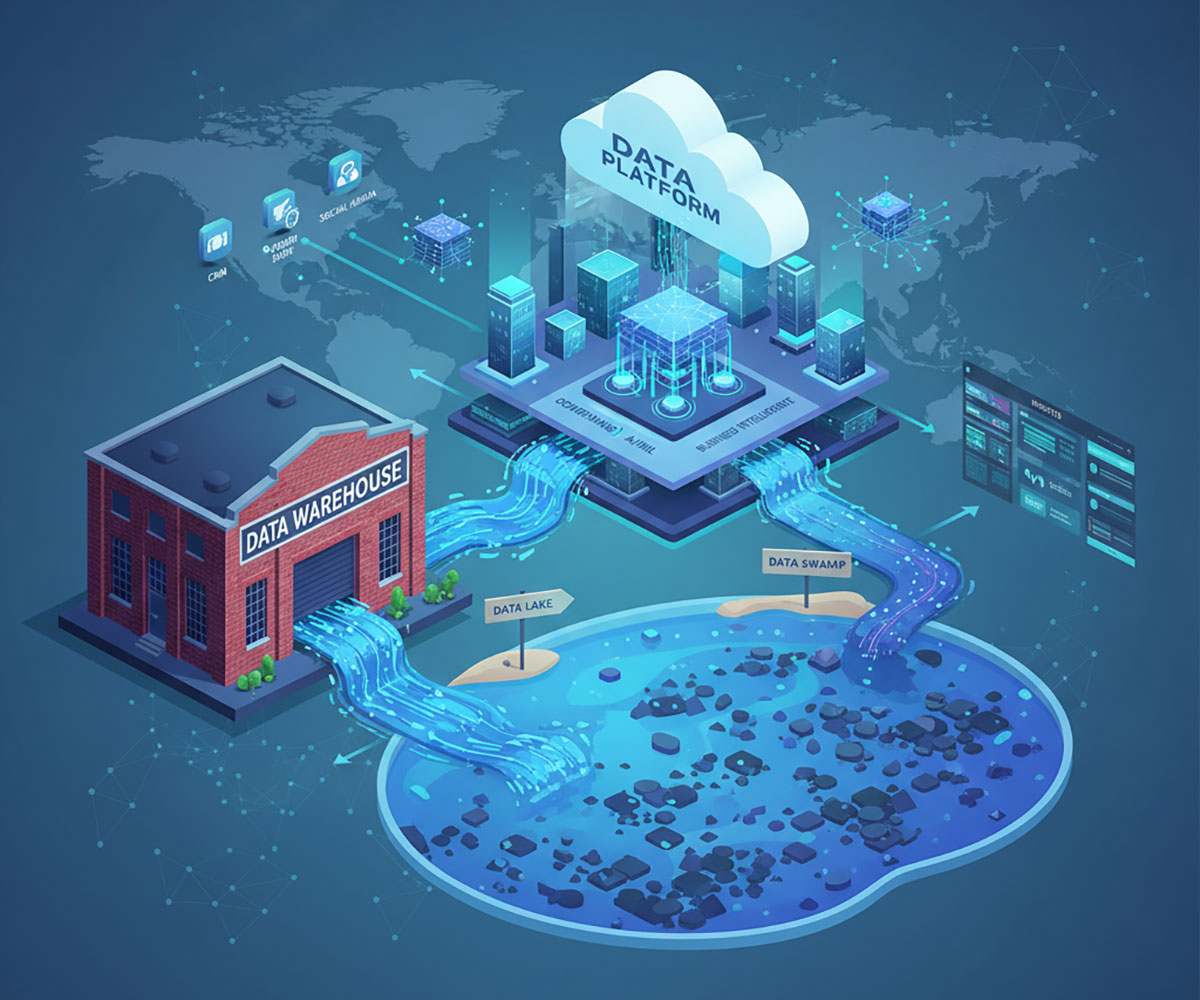
From Data Warehouse to Data Platform

From Warehouse vs. Lake to Warehouse + Lake

The debate shouldn’t be “data warehouse or data lake?” but rather “how do we combine them effectively?” Each serves a different purpose, and modern data platforms are proving that the most successful architectures leverage both.

The data lake is perfect for collecting raw, varied, and large-scale data — structured, semi-structured, or unstructured. It enables exploration, data science, and machine learning. But the data warehouse is still essential for delivering consistent, trusted, and audited data for business reporting and regulatory needs.

As one of our experts put it, the data lake can act as the source system for the data warehouse. The lake is where all data lands. The warehouse sits on top — a refined, curated layer where the most critical data is modeled, governed, and exposed to business users. Together, they form the backbone of a modern data platform.

Why the Data Warehouse Still Matters

Despite the hype around newer architectures, data warehouses provide several key benefits that data lakes alone can’t match:

  • Data Quality: Warehouses enforce rules and transformations that ensure accuracy and consistency across business domains.
  • Auditability and Compliance: Especially in industries governed by GDPR, HIPAA, or SOX, traceability is non-negotiable — something data warehouses excel at.
  • Performance and Optimization: Data warehouses are designed for analytical workloads and provide fast query performance on structured data.
  • Trust: Business users need reliable, validated data for decision-making. Data warehouses remain the single source of truth for that.

So no, the warehouse isn’t dead. It’s simply no longer alone.

Adapting to New Requirements: The Rise of Data Platforms

What has changed, however, is how organizations think about architecture. We’ve moved away from seeing data warehousing as a single monolithic system. Instead, the focus is now on building data platforms — unified ecosystems that combine the strengths of data lakes, data warehouses, and modern cloud technologies.

In this model, the data lake is used as an ingestion and exploration layer, capturing data from across the enterprise. The warehouse, meanwhile, becomes a downstream layer that provides refined, high-quality, and business-ready datasets.

This layered approach is often seen in Data Vault 2.0 architectures. The raw data is first stored in the lake (the “landing zone”), then structured into a raw vault for traceability, and finally transformed into a business vault for analytics and reporting. This methodology blends the flexibility of a lake with the governance of a warehouse — a best-of-both-worlds approach.

AI, Machine Learning, and the New Data Landscape

Another reason the “data warehouse is dead” narrative persists is the rise of AI and machine learning. These applications demand vast quantities of raw and semi-structured data — something traditional warehouses weren’t built to handle efficiently. However, this doesn’t mean warehouses are obsolete; it means they play a different role.

In AI-driven organizations, data scientists use the lake to experiment and train models. Once insights are validated, curated datasets are pushed into the warehouse to ensure they’re governed, standardized, and auditable. This workflow creates a feedback loop between the lake and the warehouse, ensuring agility without sacrificing control.

Modern data warehouses, especially cloud-native ones like Snowflake, Azure Synapse, and Google BigQuery, have also evolved. They now support semi-structured data, elastic scalability, and real-time processing — bridging the gap between lakes and traditional warehouses.

Lessons from the Field: It’s Not About Technology, It’s About Strategy

When companies struggle with data warehousing, it’s rarely because of the technology itself. More often, it’s about poor design, lack of governance, or outdated processes. As many experienced data engineers know, legacy warehouses often become complex, undocumented systems — “historically grown” solutions that no one fully understands.

The real issue isn’t whether to abandon the warehouse. It’s about how to modernize it. That means introducing automation, adopting agile data modeling techniques, and leveraging modern tools that eliminate manual maintenance work.

It also means changing the way organizations think about data. Instead of treating governance as a roadblock, teams should see it as a foundation for scalability. Instead of building massive, inflexible ETL pipelines, they should adopt modular data vault or ELT-based approaches that evolve as business needs change.

Practical Takeaways for Modern Data Teams

  • Stop chasing buzzwords. Data lakes, meshes, and fabrics are valuable, but none are silver bullets. Understand the business problem first.
  • Combine technologies strategically. Use data lakes for exploration and AI, data warehouses for governance and trust.
  • Modernize your warehouse, don’t replace it. Adopt cloud platforms and automation to remove legacy bottlenecks.
  • Think in terms of platforms. Build an integrated data ecosystem instead of disconnected tools.
  • Embrace continuous evolution. The future of data is hybrid, agile, and adaptive — not one-size-fits-all.

Conclusion: The Data Warehouse Is Evolving — Not Dead

The data warehouse isn’t a relic of the past. It’s a vital component of the modern data platform. What’s changing is the way we design, use, and integrate it. By combining the strengths of data lakes and warehouses, organizations can unlock the full potential of their data — balancing flexibility with governance, and innovation with reliability.

The future of data architecture isn’t about replacing one system with another. It’s about convergence. The warehouse, the lake, the lakehouse — all of them are part of a single, connected platform designed to empower both business users and data scientists. So no, the data warehouse isn’t dead. It’s alive, evolving, and more relevant than ever.

Watch the Video

Is the Data Warehouse Dead?

From Data Warehouse to Data Platform

Every few years, a new buzzword hits the data industry — and suddenly, the tools and methods we’ve relied on for decades are declared obsolete. Today, that target seems to be the data warehouse. Blogs and conferences proclaim its death, replaced by the data lake, data lakehouse, or even the elusive “data mesh.” But is the data warehouse really dead? Or has it simply evolved into something new?


The “Death” of the Data Warehouse: Where It All Began

For years, the data warehouse has been the foundation of enterprise analytics. It provided a structured, trusted, and governed environment where business data could be collected, cleansed, and analyzed. However, as data volumes exploded and new types of unstructured data emerged, traditional warehouses started showing their age.

Slow ETL processes, rigid schemas, and scalability issues led many to look for alternatives. Enter the data lake — a more flexible, schema-on-read environment that could store raw, unstructured data cheaply and at scale. Suddenly, the industry narrative shifted: data lakes were the future, and warehouses were history.

But as many organizations soon learned, simply dumping everything into a lake didn’t magically solve all their problems. Without governance, context, and structure, data lakes quickly turned into data swamps — massive pools of untrustworthy, undocumented information. And that’s when the story started to change again.

From Data Warehouse to Data Platform

From Warehouse vs. Lake to Warehouse + Lake

The debate shouldn’t be “data warehouse or data lake?” but rather “how do we combine them effectively?” Each serves a different purpose, and modern data platforms are proving that the most successful architectures leverage both.

The data lake is perfect for collecting raw, varied, and large-scale data — structured, semi-structured, or unstructured. It enables exploration, data science, and machine learning. But the data warehouse is still essential for delivering consistent, trusted, and audited data for business reporting and regulatory needs.

As one of our experts put it, the data lake can act as the source system for the data warehouse. The lake is where all data lands. The warehouse sits on top — a refined, curated layer where the most critical data is modeled, governed, and exposed to business users. Together, they form the backbone of a modern data platform.

Why the Data Warehouse Still Matters

Despite the hype around newer architectures, data warehouses provide several key benefits that data lakes alone can’t match:

  • Data Quality: Warehouses enforce rules and transformations that ensure accuracy and consistency across business domains.
  • Auditability and Compliance: Especially in industries governed by GDPR, HIPAA, or SOX, traceability is non-negotiable — something data warehouses excel at.
  • Performance and Optimization: Data warehouses are designed for analytical workloads and provide fast query performance on structured data.
  • Trust: Business users need reliable, validated data for decision-making. Data warehouses remain the single source of truth for that.

So no, the warehouse isn’t dead. It’s simply no longer alone.

Adapting to New Requirements: The Rise of Data Platforms

What has changed, however, is how organizations think about architecture. We’ve moved away from seeing data warehousing as a single monolithic system. Instead, the focus is now on building data platforms — unified ecosystems that combine the strengths of data lakes, data warehouses, and modern cloud technologies.

In this model, the data lake is used as an ingestion and exploration layer, capturing data from across the enterprise. The warehouse, meanwhile, becomes a downstream layer that provides refined, high-quality, and business-ready datasets.

This layered approach is often seen in Data Vault 2.0 architectures. The raw data is first stored in the lake (the “landing zone”), then structured into a raw vault for traceability, and finally transformed into a business vault for analytics and reporting. This methodology blends the flexibility of a lake with the governance of a warehouse — a best-of-both-worlds approach.

AI, Machine Learning, and the New Data Landscape

Another reason the “data warehouse is dead” narrative persists is the rise of AI and machine learning. These applications demand vast quantities of raw and semi-structured data — something traditional warehouses weren’t built to handle efficiently. However, this doesn’t mean warehouses are obsolete; it means they play a different role.

In AI-driven organizations, data scientists use the lake to experiment and train models. Once insights are validated, curated datasets are pushed into the warehouse to ensure they’re governed, standardized, and auditable. This workflow creates a feedback loop between the lake and the warehouse, ensuring agility without sacrificing control.

Modern data warehouses, especially cloud-native ones like Snowflake, Azure Synapse, and Google BigQuery, have also evolved. They now support semi-structured data, elastic scalability, and real-time processing — bridging the gap between lakes and traditional warehouses.

Lessons from the Field: It’s Not About Technology, It’s About Strategy

When companies struggle with data warehousing, it’s rarely because of the technology itself. More often, it’s about poor design, lack of governance, or outdated processes. As many experienced data engineers know, legacy warehouses often become complex, undocumented systems — “historically grown” solutions that no one fully understands.

The real issue isn’t whether to abandon the warehouse. It’s about how to modernize it. That means introducing automation, adopting agile data modeling techniques, and leveraging modern tools that eliminate manual maintenance work.

It also means changing the way organizations think about data. Instead of treating governance as a roadblock, teams should see it as a foundation for scalability. Instead of building massive, inflexible ETL pipelines, they should adopt modular data vault or ELT-based approaches that evolve as business needs change.

Practical Takeaways for Modern Data Teams

  • Stop chasing buzzwords. Data lakes, meshes, and fabrics are valuable, but none are silver bullets. Understand the business problem first.
  • Combine technologies strategically. Use data lakes for exploration and AI, data warehouses for governance and trust.
  • Modernize your warehouse, don’t replace it. Adopt cloud platforms and automation to remove legacy bottlenecks.
  • Think in terms of platforms. Build an integrated data ecosystem instead of disconnected tools.
  • Embrace continuous evolution. The future of data is hybrid, agile, and adaptive — not one-size-fits-all.

Conclusion: The Data Warehouse Is Evolving — Not Dead

The data warehouse isn’t a relic of the past. It’s a vital component of the modern data platform. What’s changing is the way we design, use, and integrate it. By combining the strengths of data lakes and warehouses, organizations can unlock the full potential of their data — balancing flexibility with governance, and innovation with reliability.

The future of data architecture isn’t about replacing one system with another. It’s about convergence. The warehouse, the lake, the lakehouse — all of them are part of a single, connected platform designed to empower both business users and data scientists. So no, the data warehouse isn’t dead. It’s alive, evolving, and more relevant than ever.

Watch the Video

Data Governance in Agile Teams: Balancing Speed and Compliance

Agile Teams and Data Governance

In today’s fast-paced world of analytics and data-driven decision-making, organizations face a growing challenge: how to stay agile while maintaining strong data governance. For many teams, governance is seen as a roadblock — something that slows delivery, adds layers of bureaucracy, and drains motivation. But when implemented correctly, data governance doesn’t have to be a pitstop. It can actually be the engine that keeps your Formula One data team running at top speed — safely, reliably, and compliantly.


When Governance Feels Like a Pitstop

Many data professionals can relate to the frustration: you’re in the middle of a sprint, the team is shipping fast, and suddenly you have to stop everything for governance discussions. Documentation, approvals, compliance checks — they all take time. It can feel like racing a Formula One car and being forced to pull over every 100 meters.

This tension between agility and governance is common. Data engineers want to deliver quickly, while governance teams need to ensure trust, traceability, and compliance. When these two groups work in isolation, frustration grows on both sides. The result? Slower delivery, lower morale, and data that stakeholders don’t fully trust.

Formula One agile team working with data governance

Why Governance Still Matters — A Lot

Despite the frustration, data governance remains essential. With increasing regulations like GDPR and growing concerns over data privacy, security, and lineage, organizations can’t afford to ignore governance. Without it, data quickly loses reliability and can even expose the company to legal and reputational risks.

Governance provides the foundation for trustworthy data. It defines who owns the data, how it’s used, and how quality is maintained. The challenge is not whether governance should exist — it’s how it should be implemented in a way that supports agility rather than stifles it.

Breaking the “Slow vs. Fast” Mindset

One of the biggest misconceptions is that teams have to choose between being fast and being compliant. In reality, good governance can actually increase speed — if done the right way. Instead of launching massive governance projects that take months before showing value, organizations should start small.

Start with one use case. Define what data needs to be governed, what rules are necessary, and which processes can be automated. By building governance iteratively, teams can maintain momentum while gradually increasing compliance coverage. This approach mirrors agile methodology itself: small increments, continuous improvement, and fast feedback loops.

From Data Lake to Data Swamp

When governance is ignored, data platforms can quickly degrade. Data lakes, for example, often become “data swamps” — unstructured, inconsistent, and untrustworthy. Without clear ownership and metadata management, it becomes impossible to understand what’s inside, how it was sourced, or if it’s even accurate.

To prevent this, governance teams and data engineers must work together early in the project lifecycle. Metadata, lineage, and data quality checks should not be afterthoughts. By integrating these elements from the start, teams can ensure that the lake remains organized and that all data remains discoverable and auditable.

Collaboration Over Confrontation

Too often, governance and delivery teams operate like opposing forces — “the ones who slow us down” versus “the ones who don’t care about compliance.” This mindset kills productivity. The truth is, both sides share the same goal: reliable, high-quality data that supports business success.

To make governance work in agile environments, it must be treated as a team sport. Data engineers, analysts, and governance professionals should collaborate from day one, not after development is complete. Early involvement prevents costly rework and reduces the perception that governance is an obstacle.

Start Small, Then Scale

Big-bang governance projects often fail. Buying an enterprise tool and trying to document everything at once is a recipe for analysis paralysis. Instead, start with a single use case or dataset. Identify what metadata, access rules, and lineage details are truly necessary. Use that as a pilot to refine your process and showcase quick wins.

Once the first success is achieved, expand governance incrementally. This approach ensures that governance evolves naturally with the organization’s needs, rather than becoming an oversized initiative that never delivers value.

Practical Tips for Agile Data Governance

  • Integrate governance early: Bring governance experts into sprint planning and design discussions, not after development is complete.
  • Automate wherever possible: Modern tools offer built-in data lineage, metadata tracking, and policy enforcement — leverage them.
  • Adopt data vault architecture: Separate raw data (raw vault) from business logic (business vault) to ensure traceability and compliance.
  • Iterate and adapt: Governance rules should evolve just like software requirements. Continuously refine based on feedback.
  • Show value quickly: Demonstrate how governance improves quality, consistency, and trust — not just compliance.

Tools and Automation: Governance Without Overhead

Today’s data platforms — especially in Azure and other cloud ecosystems — offer native tools that make governance easier. Many ETL and metadata management platforms now include features such as:

  • Automated data lineage tracking
  • Built-in documentation and metadata management
  • Testing and validation frameworks
  • Policy enforcement and access control

Before investing in an expensive governance suite, review what’s already available in your existing stack. Often, these native features are more than enough to get started and can help you build the foundation for a more mature governance model later on.

Data Vault: A Governance Enabler

The Data Vault methodology is particularly effective for combining agility with governance. By separating raw and business layers, it provides full traceability of every transformation while supporting iterative development. Each change can be tracked and audited, ensuring compliance without slowing delivery.

This structure also supports GDPR and other data privacy requirements by isolating personally identifiable information and simplifying data lineage tracking. When implemented correctly, the Data Vault becomes a backbone for both agility and compliance.

Conclusion: Governance as a Team Sport

Data governance doesn’t have to be a roadblock for agile teams. When done right, it ensures trust, transparency, and collaboration across all stakeholders. The key is to stop viewing governance as something external to the data process. It’s an integral part of creating reliable, sustainable, and compliant data ecosystems.

Think of your data team as a Formula One crew. The engineers build speed. The governance team ensures safety and reliability. Only by working together can the car reach its full potential — fast, secure, and built to last.

Start small, collaborate early, and leverage automation. Over time, governance will shift from a burden to a strategic advantage — one that drives your organization forward with confidence.

Watch the Video

Data Governance in Agile Teams: Balancing Speed and Compliance

Agile Teams and Data Governance

In today’s fast-paced world of analytics and data-driven decision-making, organizations face a growing challenge: how to stay agile while maintaining strong data governance. For many teams, governance is seen as a roadblock — something that slows delivery, adds layers of bureaucracy, and drains motivation. But when implemented correctly, data governance doesn’t have to be a pitstop. It can actually be the engine that keeps your Formula One data team running at top speed — safely, reliably, and compliantly.


When Governance Feels Like a Pitstop

Many data professionals can relate to the frustration: you’re in the middle of a sprint, the team is shipping fast, and suddenly you have to stop everything for governance discussions. Documentation, approvals, compliance checks — they all take time. It can feel like racing a Formula One car and being forced to pull over every 100 meters.

This tension between agility and governance is common. Data engineers want to deliver quickly, while governance teams need to ensure trust, traceability, and compliance. When these two groups work in isolation, frustration grows on both sides. The result? Slower delivery, lower morale, and data that stakeholders don’t fully trust.

Formula One agile team working with data governance

Why Governance Still Matters — A Lot

Despite the frustration, data governance remains essential. With increasing regulations like GDPR and growing concerns over data privacy, security, and lineage, organizations can’t afford to ignore governance. Without it, data quickly loses reliability and can even expose the company to legal and reputational risks.

Governance provides the foundation for trustworthy data. It defines who owns the data, how it’s used, and how quality is maintained. The challenge is not whether governance should exist — it’s how it should be implemented in a way that supports agility rather than stifles it.

Breaking the “Slow vs. Fast” Mindset

One of the biggest misconceptions is that teams have to choose between being fast and being compliant. In reality, good governance can actually increase speed — if done the right way. Instead of launching massive governance projects that take months before showing value, organizations should start small.

Start with one use case. Define what data needs to be governed, what rules are necessary, and which processes can be automated. By building governance iteratively, teams can maintain momentum while gradually increasing compliance coverage. This approach mirrors agile methodology itself: small increments, continuous improvement, and fast feedback loops.

From Data Lake to Data Swamp

When governance is ignored, data platforms can quickly degrade. Data lakes, for example, often become “data swamps” — unstructured, inconsistent, and untrustworthy. Without clear ownership and metadata management, it becomes impossible to understand what’s inside, how it was sourced, or if it’s even accurate.

To prevent this, governance teams and data engineers must work together early in the project lifecycle. Metadata, lineage, and data quality checks should not be afterthoughts. By integrating these elements from the start, teams can ensure that the lake remains organized and that all data remains discoverable and auditable.

Collaboration Over Confrontation

Too often, governance and delivery teams operate like opposing forces — “the ones who slow us down” versus “the ones who don’t care about compliance.” This mindset kills productivity. The truth is, both sides share the same goal: reliable, high-quality data that supports business success.

To make governance work in agile environments, it must be treated as a team sport. Data engineers, analysts, and governance professionals should collaborate from day one, not after development is complete. Early involvement prevents costly rework and reduces the perception that governance is an obstacle.

Start Small, Then Scale

Big-bang governance projects often fail. Buying an enterprise tool and trying to document everything at once is a recipe for analysis paralysis. Instead, start with a single use case or dataset. Identify what metadata, access rules, and lineage details are truly necessary. Use that as a pilot to refine your process and showcase quick wins.

Once the first success is achieved, expand governance incrementally. This approach ensures that governance evolves naturally with the organization’s needs, rather than becoming an oversized initiative that never delivers value.

Practical Tips for Agile Data Governance

  • Integrate governance early: Bring governance experts into sprint planning and design discussions, not after development is complete.
  • Automate wherever possible: Modern tools offer built-in data lineage, metadata tracking, and policy enforcement — leverage them.
  • Adopt data vault architecture: Separate raw data (raw vault) from business logic (business vault) to ensure traceability and compliance.
  • Iterate and adapt: Governance rules should evolve just like software requirements. Continuously refine based on feedback.
  • Show value quickly: Demonstrate how governance improves quality, consistency, and trust — not just compliance.

Tools and Automation: Governance Without Overhead

Today’s data platforms — especially in Azure and other cloud ecosystems — offer native tools that make governance easier. Many ETL and metadata management platforms now include features such as:

  • Automated data lineage tracking
  • Built-in documentation and metadata management
  • Testing and validation frameworks
  • Policy enforcement and access control

Before investing in an expensive governance suite, review what’s already available in your existing stack. Often, these native features are more than enough to get started and can help you build the foundation for a more mature governance model later on.

Data Vault: A Governance Enabler

The Data Vault methodology is particularly effective for combining agility with governance. By separating raw and business layers, it provides full traceability of every transformation while supporting iterative development. Each change can be tracked and audited, ensuring compliance without slowing delivery.

This structure also supports GDPR and other data privacy requirements by isolating personally identifiable information and simplifying data lineage tracking. When implemented correctly, the Data Vault becomes a backbone for both agility and compliance.

Conclusion: Governance as a Team Sport

Data governance doesn’t have to be a roadblock for agile teams. When done right, it ensures trust, transparency, and collaboration across all stakeholders. The key is to stop viewing governance as something external to the data process. It’s an integral part of creating reliable, sustainable, and compliant data ecosystems.

Think of your data team as a Formula One crew. The engineers build speed. The governance team ensures safety and reliability. Only by working together can the car reach its full potential — fast, secure, and built to last.

Start small, collaborate early, and leverage automation. Over time, governance will shift from a burden to a strategic advantage — one that drives your organization forward with confidence.

Watch the Video

The Power of Data Contracts: From Data Chaos to Cohesion

The Power of Data Contracts

Have you ever had that feeling, the one where you wake up on a Monday morning and a familiar sense of dread washes over you? You get to your desk and hope against hope that no data pipeline has failed overnight, no dashboard has broken, and no server has crashed. For anyone working with data, this scenario is all too common. The modern data landscape is a sprawling, interconnected web where a small change in one area can trigger a cascade of failures downstream. A simple column rename, a change in data type, or an unexpected null value can bring a whole system to a grinding halt.

You spend your morning firefighting—analyzing the issue, pinpointing the source of the error, and scrambling to get everything back online. By the time you look at the clock, it’s lunchtime, and you’ve spent your entire morning just fixing a bug.

This chaos is exactly what a data contract is designed to solve. It’s a way to bring order to the madness, to create a foundation of trust and reliability. A data contract not only speeds up the bug-fixing process but also makes development and changes much easier, fostering a sense of accountability within your data teams.


What Exactly is a Data Contract?

Think of a data contract as a formal, machine-readable agreement between data producers and data consumers. It’s a pact that defines the expectations and promises between different teams in your organization. Imagine a sales dashboard team (the consumer) relying on data generated by the data engineering team (the producer). The data contract defines exactly what the data engineering team will deliver, creating a clear and reliable relationship.

Data Contract flow

While a data contract can be as detailed as needed, there are three core elements that should always be included.

1. Schema

The schema is the blueprint of your data. It defines exactly what your data will look like. This includes column names, data types, and the structure of the data. A data contract should define this schema and any potential schema changes, no matter how small. A minor change, like renaming a column, can easily break a downstream pipeline if it’s not communicated and managed properly. The schema element of the contract ensures that everyone is on the same page about the data’s structure.

2. Data Quality

Data quality is a crucial, yet often underestimated, aspect of data management. Your data contract should define data quality expectations that both producers and consumers can agree on. For example, a data warehouse team might require that a customer_id column in a source system table never be empty or null. A reporting team, on the other hand, might require that the quantity of an order never be zero. These are simple examples, but defining these expectations upfront prevents many common data problems.

3. Service Level Agreement (SLA)

An SLA is a promise that one party makes to another. In the context of a data contract, it can cover a variety of things. How quickly should a problem be fixed? How fresh does the data need to be (daily, weekly, real-time)? You can also use SLAs to manage changes. For instance, an SLA could stipulate that if the engineering team wants to rename a column, they must notify consumers one week in advance. This gives the dashboarding team time to implement the change in their reports before the new version goes live, ensuring a smooth transition without breaking anything.

Implementing Data Contracts in Practice

A data contract shouldn’t be a static PDF document that nobody uses. For it to be truly effective, it must be machine-readable and integrated into your daily workflow. Here’s how you can make that happen:

Automation is Key

Your data contract should be tested automatically against your data to ensure it’s being followed. You should also have automation in place for managing changes. For example, if a data producer updates the contract with a schema change, an automated process could send a notification to the data consumers. This automation makes people accountable for their data products. It ensures that any changes, even if they have a valid reason, are communicated clearly and don’t cause unexpected issues.

CI/CD Pipelines

You can integrate data contract checks into your Continuous Integration and Continuous Delivery (CI/CD) pipelines. Before a new deployment goes live, the pipeline can check if the changes adhere to the data contract. If they don’t, the deployment can be blocked. This prevents contract-breaking changes from ever reaching production.

Fostering Communication

While automation handles much of the communication, the ultimate goal is to foster a culture of collaboration. A data contract shouldn’t be a tool for finger-pointing (“They made the problem!”). Instead, it should be a framework that encourages teamwork, where everyone is working together to build reliable, trusted data products.

The Benefits of Data Contracts

Implementing data contracts might sound like a lot of work, especially the automation part, but the benefits are substantial:

  • Increased Developer Time: Automated testing and CI/CD pipelines significantly reduce the time spent on bug-fixing and troubleshooting. Your teams can focus on development and innovation instead of firefighting.
  • Data Reliability: With clear definitions and automated checks, your data becomes much more reliable. People can trust the data they are using, and they can easily check the contract to understand its quality and refresh schedule.
  • Autonomy: Data contracts enable autonomy. Teams can make changes and improvements without fear of breaking something downstream. They know that if a change is needed, the automated process will notify the right people, and everything can be managed safely and securely.

This newfound autonomy allows for a more dynamic and responsive data ecosystem. Teams are no longer afraid to innovate because they have a clear, safe process for doing so.

Getting Started with Data Contracts

If you’re ready to start, don’t try to tackle everything at once. Begin with a single use case—a small, easy-to-manage dataset. The goal is to test the process, not to solve every problem overnight.

  1. Start with Collaboration: Explain the benefits to your teams and get them working together. Don’t frame data contracts as a top-down mandate. Instead, show them how this will make their lives easier and their work more effective.
  2. Automate Everything: This is a critical step. Bring in DevOps expertise to help you build out automated testing and CI/CD pipelines. Look at the testing you already have in place and see how you can build on it.
  3. Remember the Culture and the Tech: Data contracts are both a cultural shift and a technical one. A PDF document alone won’t solve your problems. You need the technical implementation—the automation, the testing—to make the cultural shift truly stick.

Data contracts are a powerful tool for transforming your data landscape from a state of chaos to one of cohesion and trust. They empower your teams, increase data reliability, and free up valuable time for innovation.

Watch the Video

The Power of Data Contracts: From Data Chaos to Cohesion

The Power of Data Contracts

Have you ever had that feeling, the one where you wake up on a Monday morning and a familiar sense of dread washes over you? You get to your desk and hope against hope that no data pipeline has failed overnight, no dashboard has broken, and no server has crashed. For anyone working with data, this scenario is all too common. The modern data landscape is a sprawling, interconnected web where a small change in one area can trigger a cascade of failures downstream. A simple column rename, a change in data type, or an unexpected null value can bring a whole system to a grinding halt.

You spend your morning firefighting—analyzing the issue, pinpointing the source of the error, and scrambling to get everything back online. By the time you look at the clock, it’s lunchtime, and you’ve spent your entire morning just fixing a bug.

This chaos is exactly what a data contract is designed to solve. It’s a way to bring order to the madness, to create a foundation of trust and reliability. A data contract not only speeds up the bug-fixing process but also makes development and changes much easier, fostering a sense of accountability within your data teams.


What Exactly is a Data Contract?

Think of a data contract as a formal, machine-readable agreement between data producers and data consumers. It’s a pact that defines the expectations and promises between different teams in your organization. Imagine a sales dashboard team (the consumer) relying on data generated by the data engineering team (the producer). The data contract defines exactly what the data engineering team will deliver, creating a clear and reliable relationship.

Data Contract flow

While a data contract can be as detailed as needed, there are three core elements that should always be included.

1. Schema

The schema is the blueprint of your data. It defines exactly what your data will look like. This includes column names, data types, and the structure of the data. A data contract should define this schema and any potential schema changes, no matter how small. A minor change, like renaming a column, can easily break a downstream pipeline if it’s not communicated and managed properly. The schema element of the contract ensures that everyone is on the same page about the data’s structure.

2. Data Quality

Data quality is a crucial, yet often underestimated, aspect of data management. Your data contract should define data quality expectations that both producers and consumers can agree on. For example, a data warehouse team might require that a customer_id column in a source system table never be empty or null. A reporting team, on the other hand, might require that the quantity of an order never be zero. These are simple examples, but defining these expectations upfront prevents many common data problems.

3. Service Level Agreement (SLA)

An SLA is a promise that one party makes to another. In the context of a data contract, it can cover a variety of things. How quickly should a problem be fixed? How fresh does the data need to be (daily, weekly, real-time)? You can also use SLAs to manage changes. For instance, an SLA could stipulate that if the engineering team wants to rename a column, they must notify consumers one week in advance. This gives the dashboarding team time to implement the change in their reports before the new version goes live, ensuring a smooth transition without breaking anything.

Implementing Data Contracts in Practice

A data contract shouldn’t be a static PDF document that nobody uses. For it to be truly effective, it must be machine-readable and integrated into your daily workflow. Here’s how you can make that happen:

Automation is Key

Your data contract should be tested automatically against your data to ensure it’s being followed. You should also have automation in place for managing changes. For example, if a data producer updates the contract with a schema change, an automated process could send a notification to the data consumers. This automation makes people accountable for their data products. It ensures that any changes, even if they have a valid reason, are communicated clearly and don’t cause unexpected issues.

CI/CD Pipelines

You can integrate data contract checks into your Continuous Integration and Continuous Delivery (CI/CD) pipelines. Before a new deployment goes live, the pipeline can check if the changes adhere to the data contract. If they don’t, the deployment can be blocked. This prevents contract-breaking changes from ever reaching production.

Fostering Communication

While automation handles much of the communication, the ultimate goal is to foster a culture of collaboration. A data contract shouldn’t be a tool for finger-pointing (“They made the problem!”). Instead, it should be a framework that encourages teamwork, where everyone is working together to build reliable, trusted data products.

The Benefits of Data Contracts

Implementing data contracts might sound like a lot of work, especially the automation part, but the benefits are substantial:

  • Increased Developer Time: Automated testing and CI/CD pipelines significantly reduce the time spent on bug-fixing and troubleshooting. Your teams can focus on development and innovation instead of firefighting.
  • Data Reliability: With clear definitions and automated checks, your data becomes much more reliable. People can trust the data they are using, and they can easily check the contract to understand its quality and refresh schedule.
  • Autonomy: Data contracts enable autonomy. Teams can make changes and improvements without fear of breaking something downstream. They know that if a change is needed, the automated process will notify the right people, and everything can be managed safely and securely.

This newfound autonomy allows for a more dynamic and responsive data ecosystem. Teams are no longer afraid to innovate because they have a clear, safe process for doing so.

Getting Started with Data Contracts

If you’re ready to start, don’t try to tackle everything at once. Begin with a single use case—a small, easy-to-manage dataset. The goal is to test the process, not to solve every problem overnight.

  1. Start with Collaboration: Explain the benefits to your teams and get them working together. Don’t frame data contracts as a top-down mandate. Instead, show them how this will make their lives easier and their work more effective.
  2. Automate Everything: This is a critical step. Bring in DevOps expertise to help you build out automated testing and CI/CD pipelines. Look at the testing you already have in place and see how you can build on it.
  3. Remember the Culture and the Tech: Data contracts are both a cultural shift and a technical one. A PDF document alone won’t solve your problems. You need the technical implementation—the automation, the testing—to make the cultural shift truly stick.

Data contracts are a powerful tool for transforming your data landscape from a state of chaos to one of cohesion and trust. They empower your teams, increase data reliability, and free up valuable time for innovation.

Watch the Video

Rising Complexity in BI Solutions

Introduction to BI Solutions

Business intelligence (BI) and AI-driven analytics are no longer niche support functions — they are strategic products that touch product, ops, finance, compliance and customer experience. As BI expands from traditional reporting into real-time analytics, predictive modeling and self-service, the shape of data teams and the way they work are changing fast. This article summarizes the main drivers of that change, the practical impacts on teams and projects, and concrete responses you can apply now to reduce risk and keep delivering value.


Why complexity is rising: five key challenges

Modern BI projects are visiting new territory. Below are five core challenges that repeatedly appear across industries and organizations.

1. Broader scope

BI today must do more than historical reporting. Stakeholders expect real-time dashboards, anomaly detection, predictive forecasts and self-service capabilities — often from the same platform. That breadth increases integration points, testing surface and the number of decisions that must be made early in the project.

2. Broader skillset

Delivering modern analytics requires a richer set of roles: data engineers who build pipelines, data modelers who craft semantic layers, data scientists who build predictive models, UX designers who make outputs usable, and governance specialists who protect privacy and ensure compliance. It’s rare for one person to cover all of these competently.

3. Increased coordination

More roles equals more handoffs. Each handoff is a potential point of misunderstanding — different assumptions, different definitions, different delivery cadences. Without deliberate coordination, projects fragment into disconnected workstreams.

4. Technical revolution

BI and cloud platforms evolve rapidly. New services, improved runtimes and updated best practices arrive often. Teams must continuously upskill and decide which innovations to adopt, and when. Certification cycles and vendor roadmaps move fast — staying current costs time and creates churn.

5. Balancing agility and governance

Stakeholders want rapid delivery and iterative improvement. At the same time, many industries require strict data handling, privacy controls and auditability. Finding an operating model that supports quick experiments while preserving accuracy and regulatory compliance is a central tension for modern BI teams.

Typical impacts on organizations

Those drivers produce predictable impacts on teams and delivery models. If unaddressed, they create bottlenecks and risk.

  • Role specialization: Teams move toward niche expertise rather than single-person full-stack delivery. That boosts depth but can reduce flexibility.
  • Stronger collaboration needs: Alignment across roles becomes essential to avoid silos and inconsistent decisions.
  • Higher dependency chains: A delay in one role (e.g., data engineering) can block downstream teams (reporting, model validation).
  • Greater governance needs: Shared definitions, standards and processes become mandatory to ensure trust, auditability and repeatability.

Practical responses: four core actions

Complexity is manageable when teams adopt clear practices focused on responsibility, agility, shared knowledge and training. Below are four practical responses that reduce friction and increase predictability.

1. Define clear responsibilities

Clarify who owns each stage of the data lifecycle: extraction, transformation, modeling, publication and maintenance. Use simple role definitions and RACI (Responsible, Accountable, Consulted, Informed) charts for every project. When people know who to ask and who will act, coordination overhead drops and turnaround time improves.

2. Use the best agile approach for your context

Agile isn’t one-size-fits-all. For a fast-moving SaaS product team, continuous delivery and short sprints might be ideal. For a bank with heavy regulation, a scaled framework with gated releases and stronger QA may be necessary. Choose the agile flavor (Scrum, Kanban, SAFe or a hybrid) that balances speed with the required controls — and make those rules explicit to stakeholders.

3. Implement shared documentation and data cataloging

Documentation isn’t optional — it is the connective tissue of modern BI. Practical, searchable documentation and a data catalog with lineage, owners and semantic definitions reduce onboarding time and prevent duplicated work. Track data lineage so teams can answer “where did this value come from?” quickly, and attach clear owners to key datasets and metrics.

4. Invest in cross-training

Cross-training creates T-shaped team members: specialists with enough adjacent knowledge to collaborate effectively. Data engineers who understand reporting constraints, and BI analysts who understand pipeline limitations, can resolve many issues without escalating. Cross-training also builds empathy — teams that understand each other’s constraints make better trade-offs.

Operational checklist you can use today

Use this short checklist to reduce immediate friction on a new or existing BI project.

  1. Run a one-hour roles workshop: Map responsibilities and publish a RACI for the first three deliverables.
  2. Choose an agile cadence: Decide sprint length, release gates and who signs off on production models or dashboards.
  3. Set up a minimal data catalog: Start with your top 10 datasets and add owners, a short description and lineage.
  4. Schedule cross-training sessions: One hour per week where a team member shares how they work and what they need from others.
  5. Document privacy and compliance rules: Keep them accessible and tie them to datasets and pipelines.

Common pitfalls and how to avoid them

Even with good intentions, teams stumble. Here are three pitfalls to watch for and short fixes.

Pitfall: Documentation as a chore

Fix: Make documentation part of the workflow. Use templates, require a one-line summary when a dataset changes, and keep a lightweight catalog rather than one massive, stale repository.

Pitfall: Over-specialization that creates handoff bottlenecks

Fix: Rotate or pair people for critical tasks. Pair a report developer with the data engineer for the first run of a new dashboard so knowledge spreads and the dependency weakens.

Pitfall: Chasing every new tool

Fix: Adopt a “value before novelty” rule. Evaluate new technologies against clear criteria: maintainability, onboarding cost, security and measurable improvement to outcomes.

Leadership and culture: the invisible infrastructure

Technical practices are important, but culture and leadership set the pace. Leaders must invest time in alignment, create incentives for collaboration and reward knowledge sharing. Prioritize outcomes (business impact) over tool novelty, and create safe spaces for cross-role feedback so teams can continuously improve.

Case example (illustrative)

Imagine a retail company expanding its BI program to support personalized promotions. The team must deliver real-time stock levels, predictive demand models and marketer self-service dashboards. If data engineering, modeling and UX are siloed, the marketer receives dashboards with stale inventory and models that don’t incorporate seasonal signals. If the company instead defines clear dataset ownership, runs weekly cross-functional reviews, and keeps a living data catalog, the same project becomes manageable: engineers expose real-time feeds, modelers publish validated artifacts with clear assumptions, and UX designers deliver interfaces the marketers can use without ambiguity.

Key takeaways

  • BI is broader now — expect to support streaming, prediction and self-service in addition to reporting.
  • Specialization is necessary but must be counterbalanced by collaboration practices and shared documentation.
  • Pick an agile approach that matches your risk tolerance and regulatory environment.
  • Make documentation and data cataloging practical and integrated into your workflows.
  • Cross-training is a small investment with outsized returns for speed and resilience.

Watch the Video

Rising Complexity in BI Solutions

Introduction to BI Solutions

Business intelligence (BI) and AI-driven analytics are no longer niche support functions — they are strategic products that touch product, ops, finance, compliance and customer experience. As BI expands from traditional reporting into real-time analytics, predictive modeling and self-service, the shape of data teams and the way they work are changing fast. This article summarizes the main drivers of that change, the practical impacts on teams and projects, and concrete responses you can apply now to reduce risk and keep delivering value.


Why complexity is rising: five key challenges

Modern BI projects are visiting new territory. Below are five core challenges that repeatedly appear across industries and organizations.

1. Broader scope

BI today must do more than historical reporting. Stakeholders expect real-time dashboards, anomaly detection, predictive forecasts and self-service capabilities — often from the same platform. That breadth increases integration points, testing surface and the number of decisions that must be made early in the project.

2. Broader skillset

Delivering modern analytics requires a richer set of roles: data engineers who build pipelines, data modelers who craft semantic layers, data scientists who build predictive models, UX designers who make outputs usable, and governance specialists who protect privacy and ensure compliance. It’s rare for one person to cover all of these competently.

3. Increased coordination

More roles equals more handoffs. Each handoff is a potential point of misunderstanding — different assumptions, different definitions, different delivery cadences. Without deliberate coordination, projects fragment into disconnected workstreams.

4. Technical revolution

BI and cloud platforms evolve rapidly. New services, improved runtimes and updated best practices arrive often. Teams must continuously upskill and decide which innovations to adopt, and when. Certification cycles and vendor roadmaps move fast — staying current costs time and creates churn.

5. Balancing agility and governance

Stakeholders want rapid delivery and iterative improvement. At the same time, many industries require strict data handling, privacy controls and auditability. Finding an operating model that supports quick experiments while preserving accuracy and regulatory compliance is a central tension for modern BI teams.

Typical impacts on organizations

Those drivers produce predictable impacts on teams and delivery models. If unaddressed, they create bottlenecks and risk.

  • Role specialization: Teams move toward niche expertise rather than single-person full-stack delivery. That boosts depth but can reduce flexibility.
  • Stronger collaboration needs: Alignment across roles becomes essential to avoid silos and inconsistent decisions.
  • Higher dependency chains: A delay in one role (e.g., data engineering) can block downstream teams (reporting, model validation).
  • Greater governance needs: Shared definitions, standards and processes become mandatory to ensure trust, auditability and repeatability.

Practical responses: four core actions

Complexity is manageable when teams adopt clear practices focused on responsibility, agility, shared knowledge and training. Below are four practical responses that reduce friction and increase predictability.

1. Define clear responsibilities

Clarify who owns each stage of the data lifecycle: extraction, transformation, modeling, publication and maintenance. Use simple role definitions and RACI (Responsible, Accountable, Consulted, Informed) charts for every project. When people know who to ask and who will act, coordination overhead drops and turnaround time improves.

2. Use the best agile approach for your context

Agile isn’t one-size-fits-all. For a fast-moving SaaS product team, continuous delivery and short sprints might be ideal. For a bank with heavy regulation, a scaled framework with gated releases and stronger QA may be necessary. Choose the agile flavor (Scrum, Kanban, SAFe or a hybrid) that balances speed with the required controls — and make those rules explicit to stakeholders.

3. Implement shared documentation and data cataloging

Documentation isn’t optional — it is the connective tissue of modern BI. Practical, searchable documentation and a data catalog with lineage, owners and semantic definitions reduce onboarding time and prevent duplicated work. Track data lineage so teams can answer “where did this value come from?” quickly, and attach clear owners to key datasets and metrics.

4. Invest in cross-training

Cross-training creates T-shaped team members: specialists with enough adjacent knowledge to collaborate effectively. Data engineers who understand reporting constraints, and BI analysts who understand pipeline limitations, can resolve many issues without escalating. Cross-training also builds empathy — teams that understand each other’s constraints make better trade-offs.

Operational checklist you can use today

Use this short checklist to reduce immediate friction on a new or existing BI project.

  1. Run a one-hour roles workshop: Map responsibilities and publish a RACI for the first three deliverables.
  2. Choose an agile cadence: Decide sprint length, release gates and who signs off on production models or dashboards.
  3. Set up a minimal data catalog: Start with your top 10 datasets and add owners, a short description and lineage.
  4. Schedule cross-training sessions: One hour per week where a team member shares how they work and what they need from others.
  5. Document privacy and compliance rules: Keep them accessible and tie them to datasets and pipelines.

Common pitfalls and how to avoid them

Even with good intentions, teams stumble. Here are three pitfalls to watch for and short fixes.

Pitfall: Documentation as a chore

Fix: Make documentation part of the workflow. Use templates, require a one-line summary when a dataset changes, and keep a lightweight catalog rather than one massive, stale repository.

Pitfall: Over-specialization that creates handoff bottlenecks

Fix: Rotate or pair people for critical tasks. Pair a report developer with the data engineer for the first run of a new dashboard so knowledge spreads and the dependency weakens.

Pitfall: Chasing every new tool

Fix: Adopt a “value before novelty” rule. Evaluate new technologies against clear criteria: maintainability, onboarding cost, security and measurable improvement to outcomes.

Leadership and culture: the invisible infrastructure

Technical practices are important, but culture and leadership set the pace. Leaders must invest time in alignment, create incentives for collaboration and reward knowledge sharing. Prioritize outcomes (business impact) over tool novelty, and create safe spaces for cross-role feedback so teams can continuously improve.

Case example (illustrative)

Imagine a retail company expanding its BI program to support personalized promotions. The team must deliver real-time stock levels, predictive demand models and marketer self-service dashboards. If data engineering, modeling and UX are siloed, the marketer receives dashboards with stale inventory and models that don’t incorporate seasonal signals. If the company instead defines clear dataset ownership, runs weekly cross-functional reviews, and keeps a living data catalog, the same project becomes manageable: engineers expose real-time feeds, modelers publish validated artifacts with clear assumptions, and UX designers deliver interfaces the marketers can use without ambiguity.

Key takeaways

  • BI is broader now — expect to support streaming, prediction and self-service in addition to reporting.
  • Specialization is necessary but must be counterbalanced by collaboration practices and shared documentation.
  • Pick an agile approach that matches your risk tolerance and regulatory environment.
  • Make documentation and data cataloging practical and integrated into your workflows.
  • Cross-training is a small investment with outsized returns for speed and resilience.

Watch the Video

Data Lineage: Mapping Data Flows for Decisions and Compliance

What About Data Lineage?

In today’s data-driven organizations, ensuring trust, transparency, and compliance in data usage is more crucial than ever. A foundational component that enables these outcomes is data lineage mapping. It provides a visual and logical understanding of data’s journey — from its origin in source systems through various transformations to its final destination in dashboards and reports.

In this article, we’ll explore what data lineage is, why it matters for modern data teams, and how to implement it effectively using both manual and automated approaches. Whether you’re just beginning or optimizing your governance strategy, this guide will help you start small, scale smart, and deliver value early.


What is Data Lineage?

Data lineage is the process of tracking and visualizing the lifecycle of data as it moves through systems, transformations, and uses. It maps how data flows from source to destination — including every stage it touches along the way, such as staging areas, data warehouses, and reports.

For example, in a typical setup, customer data might originate in a CRM system, move through ETL pipelines into a cloud data warehouse, and end up in a business intelligence report. Data lineage helps answer: Where did this data come from? What transformations were applied? Which systems and people interacted with it?

Why Data Lineage Matters

  • Compliance and Regulation: Many regulations like GDPR and HIPAA require data traceability. Having data lineage helps organizations meet legal obligations by showing how personal or sensitive data is handled.
  • Trust and Transparency: Business users gain confidence in the reports they rely on when they can understand the data’s origin and the processes behind it.
  • Impact Analysis: With a clear lineage, you can instantly identify which reports or models are affected by changes in source systems or logic.
  • Improved Decision-Making: Accurate, well-understood data leads to better business decisions and more effective use of data products.
  • Strategic Enablement: As more people understand your data ecosystem, collaboration improves, and innovation becomes more achievable.

Simple Example of Data Lineage

Let’s break down a basic data lineage flow:

  1. Source: A CRM system collects new customer data.
  2. Processing: ETL processes extract the data and load it into a cloud data warehouse (e.g., Snowflake).
  3. Transformation: Business rules are applied in staging or modeling layers using tools like dbt.
  4. Output: The processed data is visualized in a reporting dashboard (e.g., a compliance report named CS-3239).

Each of these steps can and should be documented and tracked in your data lineage tool or framework. This becomes essential when something breaks, or compliance auditors ask for data traceability.

Capturing Data Lineage: Manual vs. Automated

Manual Mapping

In the early stages, manual mapping is a valuable exercise. Use tools like Excel, Visio, or Lucidchart to map one high-impact report end-to-end. Identify where the data comes from, how it’s transformed, and where it’s consumed. This approach is resource-intensive and doesn’t scale, but it’s a powerful first step for:

  • Understanding your data landscape
  • Validating with data owners and stewards
  • Testing your understanding before committing to tooling

Automated Tools

For scalable implementation, automated data lineage tools are essential. Options include:

  • Datahub
  • Collibra
  • Informatica
  • Microsoft Purview
  • OpenLineage

These tools automatically gather metadata from your systems and visualize data flows. However, automation still requires configuration, integration, and validation. No tool does it all out of the box.

Best Practice: Integrate your data lineage with your business glossary and data catalog. This creates a connected governance ecosystem, where clicking on a data object reveals lineage, definitions, and ownership.

Quick Wins to Get Started

Here’s a practical, proven strategy to build momentum:

  1. Start Small: Identify one critical report or dataset that is heavily used or often misunderstood.
  2. Map Manually: Trace its data lineage from source to consumption. Focus on transformations and logic.
  3. Validate: Work with data owners, analysts, and engineers to validate the map.
  4. Test Tooling: Use this one case to evaluate lineage tools. Compare ease of integration, visibility, and automation.
  5. Integrate: Tie lineage into your broader governance structure — glossary, catalog, ownership, and quality.

This approach helps you avoid “big bang” governance failures. Starting with a focused win builds trust and demonstrates value to other teams.

Common Pitfalls to Avoid

  • Overengineering: Avoid making your first project too large. Focus on delivering a working example fast.
  • Ignoring Technical Setup: Before choosing a tool, check with your engineering teams. They may already be using dbt or similar tools that support lineage.
  • Lack of Collaboration: Governance is a team sport. Include data stewards, engineers, analysts, and business users.

Key Takeaways

  • Data lineage provides control and clarity over your data landscape, enabling better decisions and easier compliance.
  • Start small and iterate. One validated report lineage is worth more than 10 unfinished diagrams.
  • Work cross-functionally. Involve both governance and technical stakeholders early in the process.
  • Leverage what you already have. Tools like dbt, Snowflake, and BI platforms may already offer lineage features.
  • Choose tools carefully. Test with real examples before rolling out across the organization.

Final Thoughts

Data lineage mapping is no longer a luxury — it’s a necessity for organizations that aim to be data-driven, compliant, and transparent. Whether you’re leading a governance initiative or optimizing data operations, understanding your data’s journey is the foundation of success.

If you’re interested in a more detailed session on tooling or implementation strategies, feel free to reach out via LinkedIn or the contact form. Let’s bring visibility and trust into your data ecosystem.

Watch the Video

Data Lineage: Mapping Data Flows for Decisions and Compliance

What About Data Lineage?

In today’s data-driven organizations, ensuring trust, transparency, and compliance in data usage is more crucial than ever. A foundational component that enables these outcomes is data lineage mapping. It provides a visual and logical understanding of data’s journey — from its origin in source systems through various transformations to its final destination in dashboards and reports.

In this article, we’ll explore what data lineage is, why it matters for modern data teams, and how to implement it effectively using both manual and automated approaches. Whether you’re just beginning or optimizing your governance strategy, this guide will help you start small, scale smart, and deliver value early.


What is Data Lineage?

Data lineage is the process of tracking and visualizing the lifecycle of data as it moves through systems, transformations, and uses. It maps how data flows from source to destination — including every stage it touches along the way, such as staging areas, data warehouses, and reports.

For example, in a typical setup, customer data might originate in a CRM system, move through ETL pipelines into a cloud data warehouse, and end up in a business intelligence report. Data lineage helps answer: Where did this data come from? What transformations were applied? Which systems and people interacted with it?

Why Data Lineage Matters

  • Compliance and Regulation: Many regulations like GDPR and HIPAA require data traceability. Having data lineage helps organizations meet legal obligations by showing how personal or sensitive data is handled.
  • Trust and Transparency: Business users gain confidence in the reports they rely on when they can understand the data’s origin and the processes behind it.
  • Impact Analysis: With a clear lineage, you can instantly identify which reports or models are affected by changes in source systems or logic.
  • Improved Decision-Making: Accurate, well-understood data leads to better business decisions and more effective use of data products.
  • Strategic Enablement: As more people understand your data ecosystem, collaboration improves, and innovation becomes more achievable.

Simple Example of Data Lineage

Let’s break down a basic data lineage flow:

  1. Source: A CRM system collects new customer data.
  2. Processing: ETL processes extract the data and load it into a cloud data warehouse (e.g., Snowflake).
  3. Transformation: Business rules are applied in staging or modeling layers using tools like dbt.
  4. Output: The processed data is visualized in a reporting dashboard (e.g., a compliance report named CS-3239).

Each of these steps can and should be documented and tracked in your data lineage tool or framework. This becomes essential when something breaks, or compliance auditors ask for data traceability.

Capturing Data Lineage: Manual vs. Automated

Manual Mapping

In the early stages, manual mapping is a valuable exercise. Use tools like Excel, Visio, or Lucidchart to map one high-impact report end-to-end. Identify where the data comes from, how it’s transformed, and where it’s consumed. This approach is resource-intensive and doesn’t scale, but it’s a powerful first step for:

  • Understanding your data landscape
  • Validating with data owners and stewards
  • Testing your understanding before committing to tooling

Automated Tools

For scalable implementation, automated data lineage tools are essential. Options include:

  • Datahub
  • Collibra
  • Informatica
  • Microsoft Purview
  • OpenLineage

These tools automatically gather metadata from your systems and visualize data flows. However, automation still requires configuration, integration, and validation. No tool does it all out of the box.

Best Practice: Integrate your data lineage with your business glossary and data catalog. This creates a connected governance ecosystem, where clicking on a data object reveals lineage, definitions, and ownership.

Quick Wins to Get Started

Here’s a practical, proven strategy to build momentum:

  1. Start Small: Identify one critical report or dataset that is heavily used or often misunderstood.
  2. Map Manually: Trace its data lineage from source to consumption. Focus on transformations and logic.
  3. Validate: Work with data owners, analysts, and engineers to validate the map.
  4. Test Tooling: Use this one case to evaluate lineage tools. Compare ease of integration, visibility, and automation.
  5. Integrate: Tie lineage into your broader governance structure — glossary, catalog, ownership, and quality.

This approach helps you avoid “big bang” governance failures. Starting with a focused win builds trust and demonstrates value to other teams.

Common Pitfalls to Avoid

  • Overengineering: Avoid making your first project too large. Focus on delivering a working example fast.
  • Ignoring Technical Setup: Before choosing a tool, check with your engineering teams. They may already be using dbt or similar tools that support lineage.
  • Lack of Collaboration: Governance is a team sport. Include data stewards, engineers, analysts, and business users.

Key Takeaways

  • Data lineage provides control and clarity over your data landscape, enabling better decisions and easier compliance.
  • Start small and iterate. One validated report lineage is worth more than 10 unfinished diagrams.
  • Work cross-functionally. Involve both governance and technical stakeholders early in the process.
  • Leverage what you already have. Tools like dbt, Snowflake, and BI platforms may already offer lineage features.
  • Choose tools carefully. Test with real examples before rolling out across the organization.

Final Thoughts

Data lineage mapping is no longer a luxury — it’s a necessity for organizations that aim to be data-driven, compliant, and transparent. Whether you’re leading a governance initiative or optimizing data operations, understanding your data’s journey is the foundation of success.

If you’re interested in a more detailed session on tooling or implementation strategies, feel free to reach out via LinkedIn or the contact form. Let’s bring visibility and trust into your data ecosystem.

Watch the Video

From Warehouses to Platforms: Why Should We Change Our Wording?

From Data Warehouses to Data Platforms

The world of data architecture is evolving — fast. What started as traditional data warehouses has now become a dynamic ecosystem of technologies, roles, and use cases. At Scalefree, we no longer talk exclusively about data warehouses — we intentionally use the term data platforms. Why? Because it’s not just the technology that has changed, but also the people working with data and how they use it to generate value.


From Data Warehouses to Data Ecosystems

Traditional data warehouses were built for structured data with predefined schemas — relational, static, and stable. They were and still are the backbone for reporting and classic business intelligence in most cases.

The advent of data lakes offered a revolutionary capacity to house and manipulate unstructured data. However, the absence of clear structure and robust governance often resulted in environments colloquially known as “data swamps.”

Hybrid architectures and, later, data lakehouses emerged as a logical evolution, blending the strengths of warehouses and lakes. Their key benefit: enabling different data consumers to work on a unified foundation.

The New Reality: Platforms Instead of Silos
Today, multiple roles interact with data — and each has unique needs:

Data Engineers work across all architectural layers: from raw data ingestion to business rules and curated marts.

Business Analysts need structured, refined data for reports and dashboards.

Data Scientists explore raw, granular data for predictive models — often working directly with data lakes or raw vaults.

The traditional concept of a data warehouse no longer covers this variety of use cases. It’s simply not enough.

Why We at Scalefree Speak of Data Platforms

To us, Data Platform is not just a buzzword — it’s a strategic shift that reflects today’s real-world demands. A data platform needs to fulfill multiple criteria.
For example:

Neutrality
It’s not tied to specific technologies. Whether Snowflake, Databricks, or Coalesce — the concept stays relevant.

Flexibility
It supports any data architecture: from classic warehouses to lakes and lakehouses — and whatever comes next.

Role Inclusivity
All roles — engineers, analysts, scientists — can work on the same platform, using the same data, without structural or technical barriers.

Future-Readiness
New technologies can be adopted without redefining the concept of the platform itself.

AI Enablement
A modern data platform provides the foundation for AI and machine learning by making all relevant data — structured and unstructured — accessible, governable, and ready for advanced modeling.

Conclusion: Thinking in Platforms that serves EVERYONE

The world of data is no longer binary. It’s not just “reporting” vs. “analytics,” “structured” vs. “unstructured,” or “IT” vs. “business.”

By using the term Data Platform, we acknowledge this reality and offer a unifying concept that bridges technology, people, and innovation.

At Scalefree, we actively help shape this new world — using modern architectures, Data Vault 2.0, automation tools like dbt, Coalesce, and cloud-native platforms.

Watch the Video

From Warehouses to Platforms: Why Should We Change Our Wording?

From Data Warehouses to Data Platforms

The world of data architecture is evolving — fast. What started as traditional data warehouses has now become a dynamic ecosystem of technologies, roles, and use cases. At Scalefree, we no longer talk exclusively about data warehouses — we intentionally use the term data platforms. Why? Because it’s not just the technology that has changed, but also the people working with data and how they use it to generate value.


From Data Warehouses to Data Ecosystems

Traditional data warehouses were built for structured data with predefined schemas — relational, static, and stable. They were and still are the backbone for reporting and classic business intelligence in most cases.

The advent of data lakes offered a revolutionary capacity to house and manipulate unstructured data. However, the absence of clear structure and robust governance often resulted in environments colloquially known as “data swamps.”

Hybrid architectures and, later, data lakehouses emerged as a logical evolution, blending the strengths of warehouses and lakes. Their key benefit: enabling different data consumers to work on a unified foundation.

The New Reality: Platforms Instead of Silos
Today, multiple roles interact with data — and each has unique needs:

Data Engineers work across all architectural layers: from raw data ingestion to business rules and curated marts.

Business Analysts need structured, refined data for reports and dashboards.

Data Scientists explore raw, granular data for predictive models — often working directly with data lakes or raw vaults.

The traditional concept of a data warehouse no longer covers this variety of use cases. It’s simply not enough.

Why We at Scalefree Speak of Data Platforms

To us, Data Platform is not just a buzzword — it’s a strategic shift that reflects today’s real-world demands. A data platform needs to fulfill multiple criteria.
For example:

Neutrality
It’s not tied to specific technologies. Whether Snowflake, Databricks, or Coalesce — the concept stays relevant.

Flexibility
It supports any data architecture: from classic warehouses to lakes and lakehouses — and whatever comes next.

Role Inclusivity
All roles — engineers, analysts, scientists — can work on the same platform, using the same data, without structural or technical barriers.

Future-Readiness
New technologies can be adopted without redefining the concept of the platform itself.

AI Enablement
A modern data platform provides the foundation for AI and machine learning by making all relevant data — structured and unstructured — accessible, governable, and ready for advanced modeling.

Conclusion: Thinking in Platforms that serves EVERYONE

The world of data is no longer binary. It’s not just “reporting” vs. “analytics,” “structured” vs. “unstructured,” or “IT” vs. “business.”

By using the term Data Platform, we acknowledge this reality and offer a unifying concept that bridges technology, people, and innovation.

At Scalefree, we actively help shape this new world — using modern architectures, Data Vault 2.0, automation tools like dbt, Coalesce, and cloud-native platforms.

Watch the Video

Close Menu