
Scalefree tested whether AI can replace a Data Vault Engineer. The accuracy was perfect. The effort and performance gap told a very different story.
Every data team is asking the same question right now. If AI can write SQL, generate documentation, and query complex structures on its own, what exactly is the Data Engineer still doing?
Can an AI agent query a Raw Data Vault on its own? Does a business still need experienced engineers to model, document, and maintain a vault if the AI can just figure it out? We ran the experiment ourselves. The results were not what we expected.
Mastering Conversational Analytics: A Practical Guide to Setup, Testing, and Optimization
Learn how to unlock the ability to “chat” with your company’s data in plain English and get instant, accurate answers using your unique metrics. This practical webinar will demonstrate a strategy that prevents AI hallucinations and implements reliable AI data assistants without requiring a massive, expensive complexity overhaul. Sign up for our upcoming webinar on June 16th, 2026!
Sound Familiar?
Your LinkedIn feed is full of it. “AI can write SQL.” “Just ask your data a question.” “No engineer needed.” And honestly, some of it is true. AI agents are getting remarkably good at querying data structures that would have required a specialist just two years ago.
So the question is fair. If an AI can navigate Raw Data Vault entities, join Hubs to Links to Satellites, and return a correct answer, what is the Data Vault Engineer actually still doing?
At Scalefree, we decided to stop debating it and start measuring it. Same data, same AI agent, two architectures. A lean 9-column Fact Table on one side. A full 12-table Raw Data Vault on the other. Twenty questions fired at both.
The accuracy result? Equal. The full picture? A lot more interesting.
The Setup Behind the Scores
Both agents were built using Google’s Gemini Data Analytics SDK, a ready-to-use Python toolkit that connects directly to BigQuery and handles the NL2SQL pipeline out of the box. Before either agent could answer a single question though, both needed a detailed set of system instructions. Table descriptions, field definitions, glossary terms, query guidance. And behind every one of those lines is someone who knows the data well enough to describe it accurately. That person does not go away with AI. They become more important.
Here is what that looked like in practice.
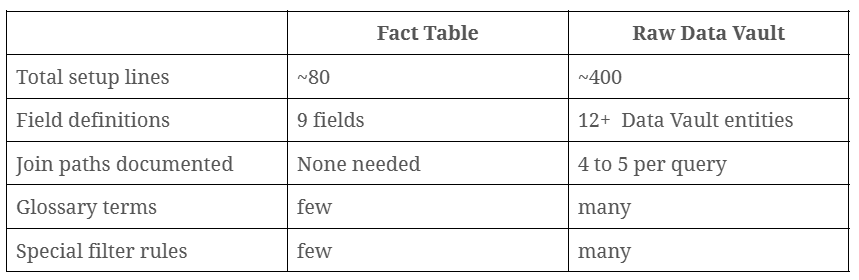
The Fact Table instructions fit in one sitting. The Raw Vault required documenting every join path, every satellite filter, and every entity relationship before the agent could reason correctly. That is 5 times more documentation for the exact same end result.
Build Better Data Platforms
Practical architecture insights for modern data teams. Join 8,000+ data professionals.
Get Free InsightsPutting Both to the Test
The test was designed to build up gradually. The first five questions kept it simple: total booking counts, filtering by office location. Then came date and time logic: specific days, monthly ranges, daily breakdowns. The middle tier pushed into duration analysis: average booking lengths, the longest slot, exact minute matches. After that, day-of-week patterns: which weekday is busiest, how Mondays compare. The final five combined everything at once, multi-dimensional queries that needed location, time, and resource type all in a single answer. Here is an excerpt from the final three tiers:

Excerpt of the 20-question benchmark test suite
One deliberate design choice: no personal data. Names and email addresses live in a restricted part of the vault that the agent cannot access. The Fact Table was built to match that boundary from the start. Fair test, clean data governance.
The Results
Honestly? Nobody expected a clean sweep on accuracy. And between us, as Data Vault engineers, we were hoping it would not.
Both architectures answered every single question correctly. The AI agent handled a 12-table vault with Hubs, Links, and Satellites just as confidently as a single flat table. That is genuinely impressive, and honestly a little humbling. It also means the modeling and documentation were done right. You cannot score 20 out of 20 on a poorly described structure.
But then look at the last two columns. The Raw Vault took 33 minutes in total to do what the Fact Table did in 6. That is 1.65 minutes per question on average, compared to 0.3 minutes for the Fact Table. Same destination. Five times longer to get there.
What This Means for Your Business
Let’s translate the numbers into business reality.
33 minutes total query time versus 6. That is 1.65 minutes per question on average, compared to 0.3 minutes for the Fact Table. For a business user who just wants a quick answer, that difference is felt immediately. And before any of those queries even ran, the Raw Vault needed around 400 lines of system instructions written by someone who understands the data deeply enough to describe it accurately.
None of this makes the Raw Data Vault the wrong choice. For enterprise data management, it is still the gold standard. But pointing an AI agent directly at it, without a proper semantic layer and without experienced engineers maintaining it, is a fast path to slow answers and frustrated users.
Build the vault. Then build a Fact Table on top of it as the AI-facing layer. That combination gives you the best of both worlds. And it gives your Data Vault Engineer a role that AI cannot fill. Someone has to know the data well enough to describe it. Someone has to model it well enough that the AI can reason with it. That someone is not going away anytime soon.
Build Better Data Platforms
Practical architecture insights for modern data teams. Join 8,000+ data professionals.
Get Free InsightsKey Takeaways
- Do not judge your AI setup by accuracy alone. Look at query time and setup effort too.
- A well-modeled Fact Table gives you fast, reliable conversational analytics with minimal overhead.
- A Raw Data Vault can match that accuracy, but needs 5 times more documentation and runs 5 times slower.
- Good documentation requires someone who understands the data. AI cannot write that for you, at least not yet.
- The best architecture for AI analytics is not either/or. Use the vault for data integrity, the Fact Table for the AI layer.
- Your Data Vault Engineer is not a cost to cut. They are the reason any of this works.
What Comes Next
The full story gets told at our upcoming webinar: Mastering Conversational Analytics: A Practical Guide to Setup, Testing, and Optimization. Live queries. Real failure examples. A practical framework for choosing the right architecture. All of it, with the actual data behind it.
In the meantime, tell us where you are at. Are you working with a Raw Vault, a Fact Table, something else entirely? Drop a comment. We read them all.