
One question comes up again and again in modern data architecture discussions:
“If we move to a Lakehouse, do we still need Data Vault?”
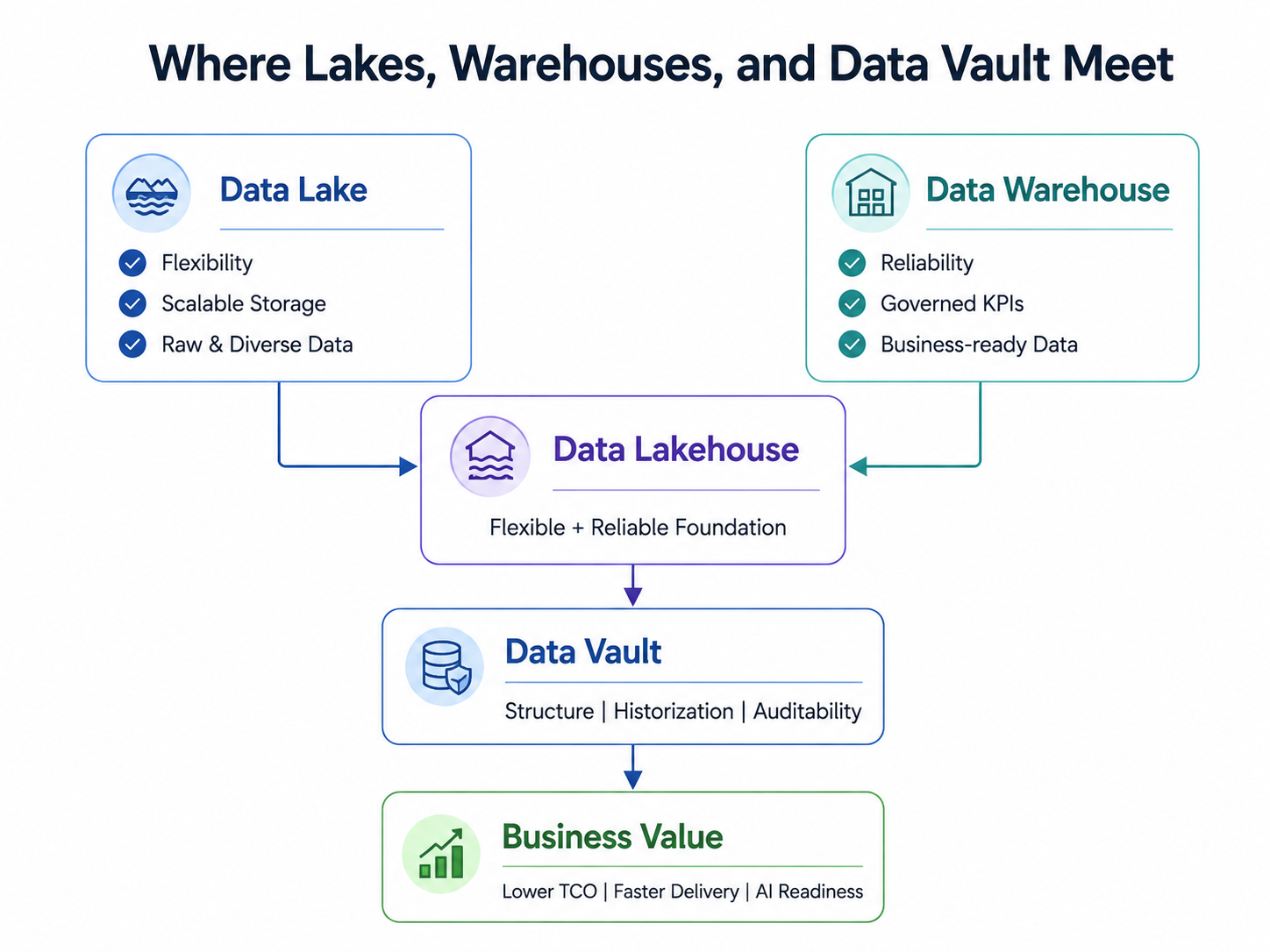
The reasoning sounds logical: modern Lakehouse platforms let you query structured data directly from cloud storage – no separate Raw Vault or Business Vault layers required in between. On top of that, built-in time travel provides point-in-time access across tables, which looks a lot like historization without the extra modeling effort. If the platform already handles storage, compute, format, direct access, and a form of history, the need for a full Data Vault methodology starts to feel less obvious.
It is a fair question. To answer it properly, we first need to clarify the core concepts behind Data Lakes, Data Warehouses, Data Lakehouses, and Data Vault. Only then can we understand where these concepts overlap, where they differ, and how they can work together in a modern data architecture.
Data Lakehouses Explained: Where Lakes, Warehouses and Data Vault Meet
Discover how Data Lakehouses combine the flexibility of Data Lakes with the reliability of Data Warehouses to transform modern data architecture. In this webinar, we break down these core concepts and explore exactly where Data Vault fits into the picture. Join us to learn how a well-designed Lakehouse can reduce complexity, optimize your Total Cost of Ownership (TCO), and build a future-ready foundation for advanced analytics and AI. Learn more in our upcoming webinar on July 21st, 2026!
Defining the Core Concepts
The public discussion around Data Lakehouses is often heavily vendor-driven. Many platforms promise lower Total Cost of Ownership, faster delivery, and better AI readiness. A well-designed Lakehouse architecture can genuinely support these goals. But only when it is treated as what it really is: an architectural pattern, not just a product you buy.
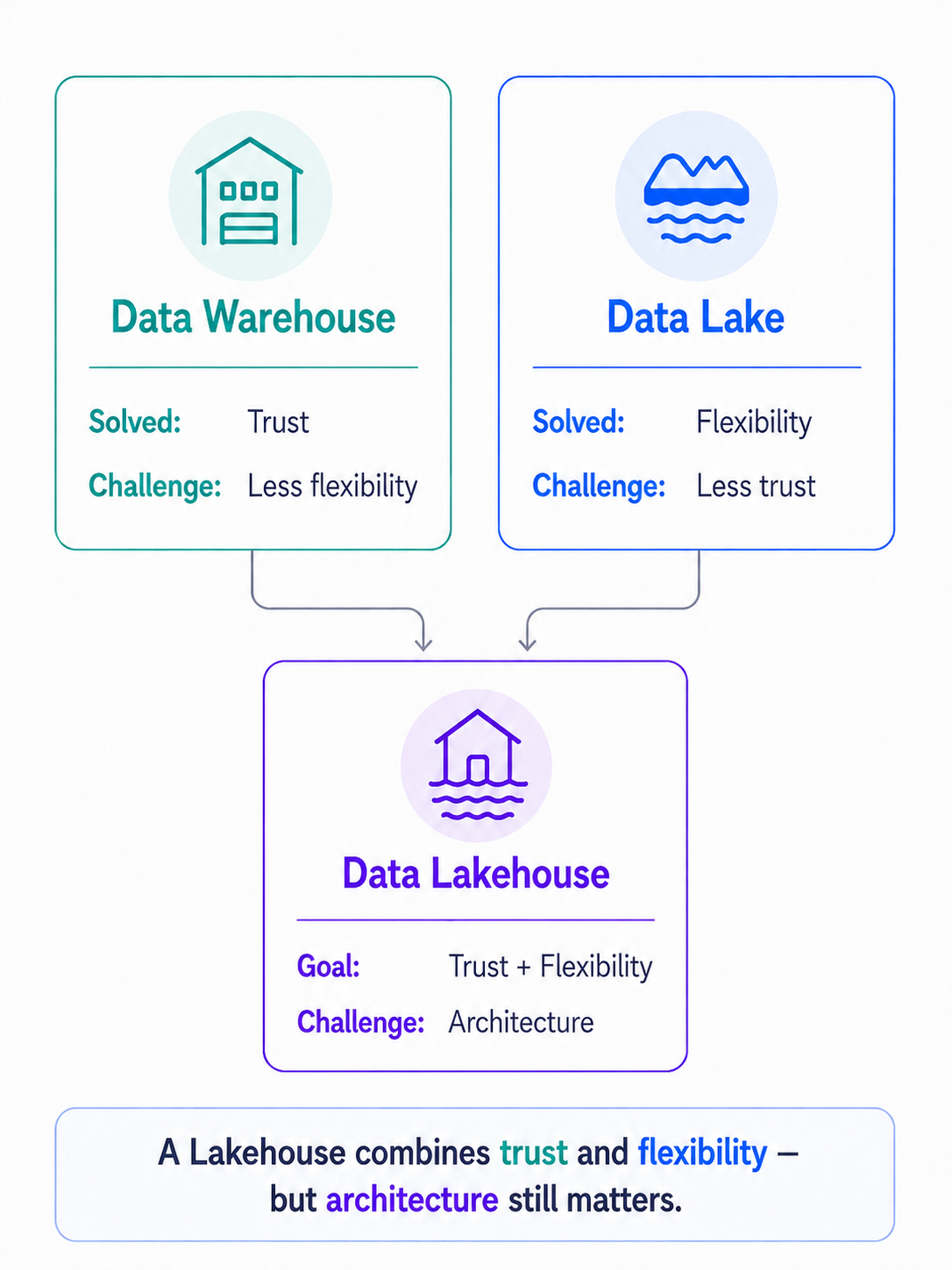
The Data Warehouse was designed to solve the trust problem. Governed KPIs, structured models, and business-ready data are what make BI dashboards reliable. The trade-off is that classical Data Warehouse architectures can become expensive at scale and are not always ideal for semi-structured data, machine learning workloads, or rapid experimentation.
The Data Lake was designed to solve the flexibility problem. It provides scalable storage, supports many data types, and creates room for exploration, data science, and advanced analytics. But without governance, clear ownership, and structure, many Data Lakes turn into Data Swamps. Finding trusted data then becomes a challenge instead of an advantage.
The Data Lakehouse tries to bring both worlds together: warehouse-like reliability on lake-like storage. Open table formats such as Apache Iceberg, Delta Lake, and Apache Hudi make it possible to add capabilities like ACID transactions, schema evolution, and time travel closer to the storage layer. That part is genuinely exciting.
But there is an important caveat that often gets lost in the hype.
The Catch: Trust Is Not Automatic
A Lakehouse does not automatically create trust. It does not automatically deliver clean KPIs, consistent business definitions, proper historization, or clear ownership. A modern Lakehouse without architectural discipline can still become a modern Data Swamp. The platform may be more scalable and cost-efficient, but the structural problems do not disappear just because the data has moved to a new storage layer.
Build Better Data Platforms
Practical architecture insights for modern data teams. Join 8,000+ data professionals.
Get Free InsightsLakehouse vs. Data Vault: Different Layers, Different Jobs
This is exactly where Data Vault comes back into the picture.
The framing of “Lakehouse vs. Data Vault” is, in my view, the wrong comparison. A Lakehouse is a platform and architecture pattern. Data Vault is a modeling and integration methodology. They operate on different layers. The Lakehouse describes where and how data can live. Data Vault describes how to model, integrate, historize, and audit data across multiple sources.
Historization: Time Travel vs. Data Vault
A common reaction to this is:
“But Lakehouses already give me time travel and snapshots, so I do not need Raw Vault or Business Vault for historization, do I?”
It is a fair assumption, but it conflates two different things. Time travel at the table format level is a powerful operational feature, valuable for short-term rollbacks and point-in-time queries on a single table. But it is not a replacement for long-term, integrated business historization across sources. Snapshots are subject to retention policies and storage maintenance routines such as VACUUM, snapshot expiration, or cleaner processes, which means they are not built for audit-grade traceability over years. Data Vault, by contrast, follows an insert-only modeling pattern that integrates entities across systems and supports long-term, auditable historization. Both have value, but they solve different problems on different time horizons.

The Synergy in Modern Data Architectures
In modern data architectures, the two can fit together very naturally. The Lakehouse provides the scalable and flexible foundation. Data Vault provides the structure that makes the data trustworthy enough for reporting, analytics, and increasingly for AI use cases. Raw Vault, Business Vault, and Information Marts can be implemented on top of a Lakehouse foundation. It is not necessarily an either-or decision.
What does this mean in business terms? A Lakehouse can help reduce duplicated storage and lower the Total Cost of Ownership. Combined with a proper modeling and governance layer, it can also reduce maintenance effort, prevent expensive reengineering cycles, and give teams the agility to deliver new data products faster.
Build Better Data Platforms
Practical architecture insights for modern data teams. Join 8,000+ data professionals.
Get Free InsightsConclusion
A Lakehouse is a powerful foundation, but it is not a shortcut around architecture. Those cost and agility benefits are real – but none of it replaces the need for clear modeling, governance, and historization. This is why Lakehouse and Data Vault are not competitors but partners: the Lakehouse provides the scalable foundation, and Data Vault provides the structure that keeps your data trustworthy, integrated, and auditable.
So the answer to our opening question is simple: no, a Lakehouse does not replace Data Vault – it gives it a more flexible foundation to run on.
Want to go deeper on this?
Join our upcoming webinar: Data Lakehouses Explained: Where Lakes, Warehouses, and Data Vault Meet. We will clarify what Data Lakes, Data Warehouses, and Data Lakehouses really are, explain why a Lakehouse is an architectural pattern rather than a shortcut around design, and show where Data Vault fits into a modern Lakehouse architecture. Whether you are exploring Lakehouses for the first time or weighing them against your existing Data Warehouse and Data Vault setup, you will leave with a clear framework for evaluating your own platform.
Join us on July 21st.
Register for free here
The data lakehouse approach combines useful capabilities from data lakes and data warehouses to support modern analytics. I find this valuable because flexible and well-structured data architecture can help businesses manage diverse data sources and make information more accessible for analysis.
The data lakehouse is interesting because it brings together flexibility and structure that are often associated with separate data architectures. Understanding where data lakes, warehouses, and Data Vault fit can make it easier to design systems that support both exploration and reliable analytics.