
search
0
All Posts By

Building a scalable Data Platform?

Whether you're implementing Data Vault 2.1 or modernizing your analytics architecture, our experts help you turn complex data challenges into practical, future-proof solutions. From hands-on implementation to in-depth training, we support your team every step of the way.

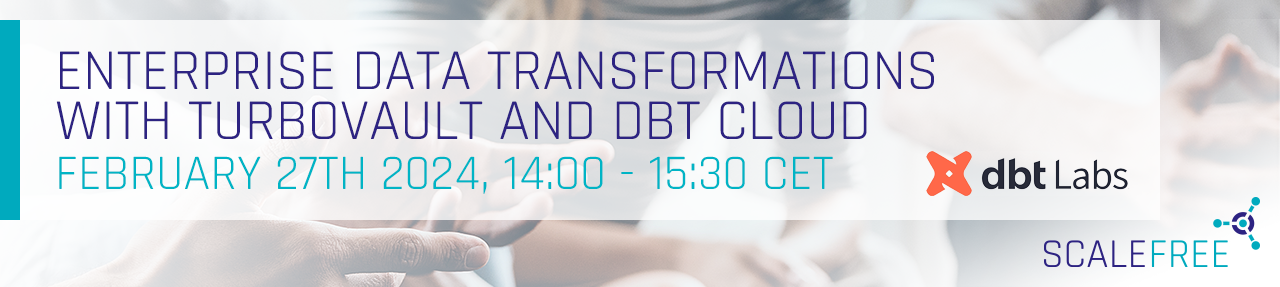
Enterprise Data Transformations with Turbovault and dbt Cloud

Watch Webinar Recording

Webinar Summary

Data Vault is vital for businesses due to its adaptability and scalability in managing dynamic data environments. Its hub-and-spoke architecture ensures traceability and agility, enabling quick adaptation to changing requirements and diverse data sources.

Come and join our upcoming webinar and learn about how to use dbt Cloud with Turbovault and a data modeling tool to implement data vault in your organization.

In this webinar you will

  • Receive a detailed 90-minute “show-and-tell” walkthrough of an end-to-end Data Vault implementation using cutting-edge tools
  • Explore the seamless integration of Ellie.ai, Turbovault4dbt, and Datavault4dbt for enhanced data modeling and automation
  • Understand the practical aspects of implementing a Data Vault without the need for a pre-configured demo environment.

Webinar Details

  • Date: 27th February
  • Time: 14:00 – 15:45 PM CET

Webinar Agenda

  1. Introduction to the Power Trio: dbt Cloud, Turbovault, and Data Modeling Tools
  2. 90-Minute “Show-and-Tell” Walkthrough of an End-to-End Data Vault Implementation
    • Using Ellie.ai for ER Model, Turbovault4dbt for dbt Automation, and Datavault4dbt for DV Model Generation
  3. Insights into Data Vault Implementation in Medium and Large Sized Companies
  4. Q&A Session with Industry Experts

In Partnership With

Speakers

Profile picture of Tim Kirschke

Tim Kirschke
Senior Consultant

Tim has a Bachelor’s degree in Applied Mathematics and has been working as a BI consultant for Scalefree since the beginning of 2021. He’s an expert in the design and implementation of BI solutions, with focus on the Data Vault 2.0 methodology. His main areas of expertise are dbt, Coalesce, and BigQuery.

Sean McIntyre

Sean McIntyre
Senior Solutions Architect

Sean is a Senior Solutions Architect at dbt Labs who works with organizations across Europe, helping them get started with and scaling dbt Cloud with Data Vault. In his last role, he was a Principal Data Engineer who implemented the modern data stack. Originally from Canada, his homebase is now Vienna.


Hash Key and Hash Diff Computation

Watch the Video

In our ongoing series, CEO Michael Olschimke  answers a question from the audience regarding Has Key and Hash Diff computation:

“What is the recommended way for Hashing? In the case of an optional relationship, should we first replace the NULL value with the default value before hashing? What is the reason for this? Should we include the BK of parent (hub/link) in calculation of Hash Diff? The above was mentioned in your book ‘Building a scalable Data Warehouse with Data Vault 2.0’ but other blogs emphasize a loading code for a satellite that compares the latest Hash Diff per Hash Key (even if BK is included in Hash Diff). Is there a specific reason?”

Specifically, the discussion delves into whether it is advisable to replace NULL values with default values before hashing in the context of an optional relationship. The rationale behind this practice and the potential inclusion of the BK of the parent (hub/link) in the calculation of Hash Diff are explored.

This topic was previously highlighted in Michael’s book ‘Building a scalable Data Warehouse with Data Vault 2.0’, but contrasting perspectives from other blogs advocate for a loading code approach for a satellite that considers the latest Hash Diff per Hash Key, even if the BK is included in the Hash Diff.

Michael sheds light on the significance of Hash Key and Hash Diff in this discussion.

Meet the Speaker

Profile picture of Michael Olschimke

Michael Olschimke

Michael has more than 15 years of experience in Information Technology. During the last eight years he has specialized in Business Intelligence topics such as OLAP, Dimensional Modelling, and Data Mining. Challenge him with your questions!

Data Vault in a Data Mesh Approach

Solutions

Data Vault & Data Mesh

Dive into the integration of Data Vault within the context of Data Mesh, the journey into the future of scalable and decentralized data architectures with our Data Vault 2.Go Newsletter, your go-to source for (almost) all things related to the cutting-edge world of data.

In this edition, we’re diving into the integration of Data Vault 2.0 within the context of a Data Mesh approach. Join the journey into the future of scalable and decentralized data architectures.

Data Vault in a Data Mesh approach

This webniar explores the integration of Data Vault within a Data Mesh approach, highlighting the synergy between Data Mesh principles and Data Vault’s scalability, flexibility, resilience, and interoperability. We’re diving into the integration of Data Vault within the context of a Data Mesh approach. A journey into the future of scalable and decentralized data architectures.

Watch webinar recording

Understanding Data Mesh: a quick recap

Before we delve into the role of Data Vault, let’s refresh our memories on what a Data Mesh is. Coined by Zhamak Dehghani, a Data Mesh is an architectural paradigm that aims to address the challenges of scaling data within large organizations. It promotes a decentralized approach to data ownership and access, treating data as a product and establishing domain-oriented, self-serve data infrastructure.

Data Vault in the Mesh: a synergistic alliance

Now, let’s talk about Data Vault. Historically recognized as a robust methodology for building enterprise data warehouses, Data Vault has proven its worth in creating scalable, flexible, and resilient data architectures. However, its integration into a Data Mesh approach adds a new layer of agility and efficiency.

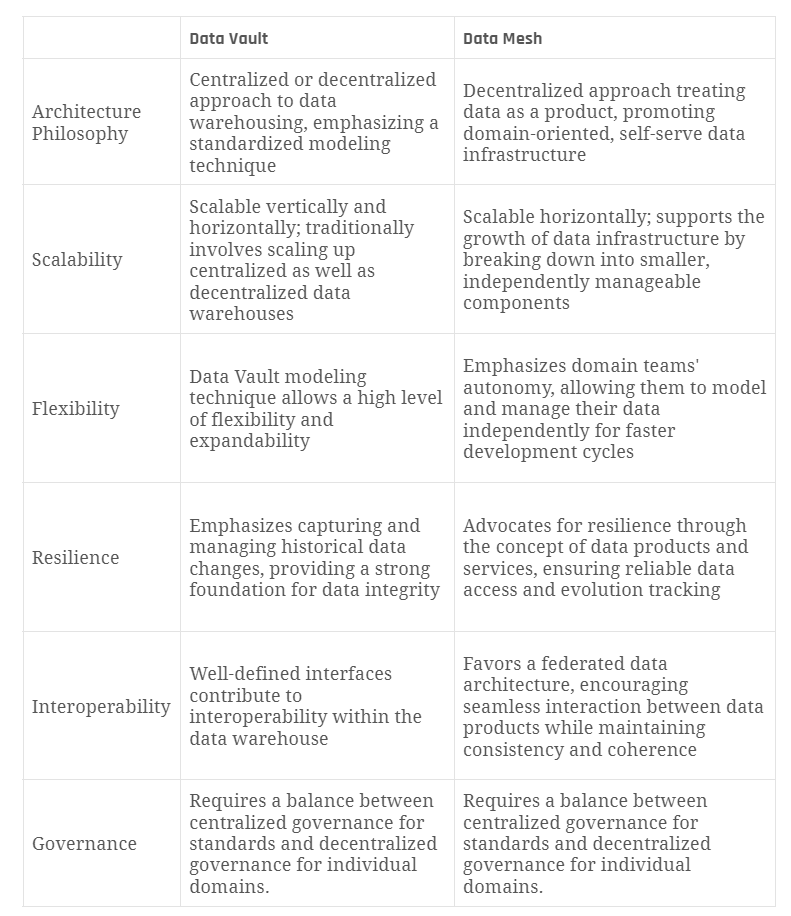
Scalability

Data Mesh emphasizes the need for decentralized data ownership, making it crucial to scale data infrastructure horizontally. Data Vault, with its modular and scalable architecture, aligns seamlessly with this requirement. By breaking down the data warehouse into smaller, manageable components, Data Vault ensures that the system can scale effortlessly as data volume and complexity increase.

Flexibility

In a Data Mesh, each domain or business unit is responsible for its own data products. Data Vault’s adaptability shines here, allowing different teams to model and manage their data independently. This flexibility enables faster development cycles and reduces dependencies on a centralized data team, empowering domain teams to innovate and iterate at their own pace.

Resilience

Data Mesh introduces the concept of data products and services, emphasizing the need for resilience in data architectures. Data Vault, with its focus on capturing and managing historical data changes, plays a crucial role in ensuring the reliability and integrity of data products. This historical record-keeping proves invaluable for auditing, compliance, and understanding the evolution of data over time.

Interoperability

A Data Mesh advocates for a federated data architecture where data products can seamlessly interact with each other. Data Vault’s standardized modeling techniques and well-defined interfaces make it easier for different domains to collaborate and share data while maintaining consistency and coherence across the entire ecosystem.

Data Mesh & Data Vault

Conclusion

The marriage of Data Vault and Data Mesh represents a leap forward in the evolution of data architectures. It combines the proven reliability of Data Vault with the agility and scalability of a decentralized Data Mesh, offering organizations a powerful solution for managing their ever-growing and diverse data landscape.

While the integration of Data Vault into a Data Mesh approach brings numerous benefits, it’s essential to acknowledge potential challenges. Managing the decentralized nature of data ownership, ensuring consistent standards across domains, and providing adequate governance are crucial aspects that require careful consideration.

Make sure to watch the webinar recording to Data Mesh in a Data Vault 2.0 approach to dive even deeper into the knowledge.

– Marc Winkelmann (Scalefree)

PIT and Effectivity Satellites

Watch the Video

In our continuous series, our CEO Michael Olschimke delves into a thought-provoking inquiry posed by a member of our audience:

“Why do numerous illustrations of Point-In-Time (PIT) tables utilize load datetimes instead of applied datetimes from the source, despite the fact that analysts generally aim to restore data for a specific datetime as it existed in the source? Are there instances of PIT table implementations that incorporate both applied datetimes and load datetimes?”

Michael delves into the intricacies of Point-In-Time (PIT) tables, exploring the rationale behind the prevalent use of load datetimes versus applied datetimes in these structures. He addresses the challenges and considerations in designing PIT tables that accurately reflect the state of data as per the source system, while also considering the need for historical restoration based on specific datetimes. Michael provides insights into potential approaches or hybrid models that combine applied datetimes and load datetimes to meet both analytical requirements and data reconstruction needs effectively within PIT table implementations.

Meet the Speaker

Profile picture of Michael Olschimke

Michael Olschimke

Michael has more than 15 years of experience in Information Technology. During the last eight years he has specialized in Business Intelligence topics such as OLAP, Dimensional Modelling, and Data Mining. Challenge him with your questions!

Data Vault Point In Time (PIT) Tables

Watch the Video

In our continuing series, our CEO, Michael Olschimke, delves into a thought-provoking question raised by an audience member regarding Point-In-Time (PIT) tables:

“I’m trying to grasp why the majority of Point-In-Time (PIT) table illustrations do not incorporate tracking satellites to accurately reconstruct the timeline for a business key. For example, I have three snapshots for business key 001 stored in satellite1. This seems inaccurate as the record was deleted from the source. Why does this prevail?”

Michael engages in a detailed discussion on the concepts of Point-In-Time (PIT) and Effectivity Satellites, shedding light on the importance of incorporating tracking satellites for maintaining data integrity and timeline accuracy in data warehousing practices.

Meet the Speaker

Profile picture of Michael Olschimke

Michael Olschimke

Michael has more than 15 years of experience in Information Technology. During the last eight years he has specialized in Business Intelligence topics such as OLAP, Dimensional Modelling, and Data Mining. Challenge him with your questions!

Dependent Child Links with Status Tracking

Watch the Video

In our ongoing series, CEO Michael Olschimke addresses a viewer’s inquiry regarding dependent child links with status tracking:

“I have a source with multiple records for one BK. I model this as a hub and a satellite with a dependent child key. As a status tracking satellite only tracks the parent key hub; how can I track the deletes of the records with the dependent child?”

The viewer presents a challenge tied to a source containing multiple records for a single Business Key (BK). Their current modeling involves a hub and a satellite with a dependent child key. However, they are grappling with how to effectively track the deletions of records associated with the dependent child, especially when a status tracking satellite typically tracks only the parent key hub.

Michael engages with this query, shedding light on strategies and best practices related to Dependent Child Links in the context of Data Vault modeling. He offers insights into addressing the specific scenario described by the viewer, providing practical guidance on tracking deletions in situations where dependent child keys are involved.

This episode serves as a valuable resource for Data Vault practitioners grappling with similar challenges in their modeling endeavors. Michael’s expertise provides clarity on how to navigate the intricacies of tracking deletions effectively within the Data Vault framework.

Meet the Speaker

Profile picture of Michael Olschimke

Michael Olschimke

Michael has more than 15 years of experience in Information Technology. During the last eight years he has specialized in Business Intelligence topics such as OLAP, Dimensional Modelling, and Data Mining. Challenge him with your questions!

Data Mining in the Data Vault Architecture

Watch the Video

In our ongoing series, CEO Michael Olschimke addresses a viewer’s question:

“We have a data mining model to be applied during information delivery. Where does it fit in the Data Vault 2.0 architecture?”

The viewer inquires about integrating a data mining model into the Data Vault 2.0 architecture specifically for information delivery. They seek guidance on where this data mining aspect fits within the broader Data Vault framework.

Michael delves into the topic of Data Mining in the context of Data Vault 2.0. He provides insights into the strategic placement of data mining models within the architecture, emphasizing their role in enhancing information delivery processes. Michael’s response sheds light on how organizations can effectively leverage data mining techniques to extract valuable insights while adhering to the principles of the Data Vault methodology.

This episode serves as a valuable resource for those navigating the intersection of data mining and Data Vault 2.0, offering practical guidance on seamlessly integrating data mining models into the architecture.

Meet the Speaker

Profile picture of Michael Olschimke

Michael Olschimke

Michael has more than 15 years of experience in Information Technology. During the last eight years he has specialized in Business Intelligence topics such as OLAP, Dimensional Modelling, and Data Mining. Challenge him with your questions!

Data Vault Naming Conventions

Watch the Video

In our continuous series, CEO Michael Olschimke addresses a viewer’s question reading naming conventions in Data Vault:

“What naming conventions do you recommend for the Data Vault model?”

The viewer seeks advice on the recommended naming conventions for structuring the Data Vault model. Recognizing the significance of clear and standardized naming in data modeling, the question focuses on eliciting practical insights and guidelines.

Michael shares his expertise on effective naming conventions tailored for Data Vault models. He emphasizes the importance of consistency, clarity, and meaningful names to enhance the comprehensibility and maintainability of the Data Vault structure. By providing practical recommendations, Michael aids viewers in establishing robust naming conventions aligned with best practices in Data Vault modeling.

This episode serves as a valuable resource for data professionals aiming to optimize their Data Vault models through well-defined and organized naming conventions.

Meet the Speaker

Profile picture of Michael Olschimke

Michael Olschimke

Michael has more than 15 years of experience in Information Technology. During the last eight years he has specialized in Business Intelligence topics such as OLAP, Dimensional Modelling, and Data Mining. Challenge him with your questions!

Modelling the Date Dimension in Data Vault

Watch the Video

In our continuous series, CEO Michael Olschimke delves into a question from the audience about how to model the date dimension in Data Vault:

“In many data sources we get data with a DATE data type. In some cases we want to use a Time-Dimension for this fields. How would you model this in Data Vault:

  •  As Time-Hub in Raw Vault and referencing that Hub in a Link?
  • As Time-Reference Table and then joining that in the IM? Should the Time Dimension hold a Hash Key as Dimension Key for that, or the Business Key (date)?
  • Or both options?”

The viewer raises a pertinent query regarding the modeling of DATE data types from various sources within the Data Vault modeling framework. The focus is on incorporating a Time-Dimension for these date fields, presenting multiple options for consideration.

Michael explores potential solutions, shedding light on two prominent strategies:

Time-Hub in Raw Vault: Creating a dedicated Time-Hub in the Raw Vault and referencing it in a Link. This approach involves establishing a distinct hub for time-related data, providing a structured foundation for subsequent processing.

Time-Reference Table in Information Mart (IM): Alternatively, considering a Time-Reference Table in the IM and joining it as needed. The discussion delves into the nuances of choosing between a Hash Key and Business Key (date) for the Time Dimension, offering insights into the implications of each choice.

Michael’s insights provide valuable guidance for navigating the complexities of modeling date dimensions within the Data Vault paradigm. By weighing the pros and cons of different approaches, viewers gain a deeper understanding of how to effectively integrate time-related data into their Data Vault architecture.

Meet the Speaker

Profile picture of Michael Olschimke

Michael Olschimke

Michael has more than 15 years of experience in Information Technology. During the last eight years he has specialized in Business Intelligence topics such as OLAP, Dimensional Modelling, and Data Mining. Challenge him with your questions!

How to Get Rid of Data Vault Load End Date

Watch the Video

In our continuous series, CEO Michael Olschimke addresses a question from the audience regarding the Load End Date in Data Vault:

“What are the options to virtualize the load end date in Data Vault? We work on an embedded solution and the Window function (LEAD/LAG) is not fast enough.”

The viewer raises a critical concern regarding the virtualization of the load end date in a Data Vault environment, especially in the context of an embedded solution. The challenge lies in the performance limitations of certain window functions like LEAD/LAG, prompting the exploration of alternative options.

Michael delves into potential strategies and solutions for efficiently managing load end dates in Data Vault. The discussion encompasses various approaches to enhance virtualization, ensuring optimal performance without compromising speed or efficiency.

By sharing insights into the intricacies of load end date virtualization, Michael provides valuable guidance for organizations grappling with embedded solutions. The exploration of alternatives offers a nuanced perspective on optimizing this crucial aspect within the Data Vault framework.

Meet the Speaker

Profile picture of Michael Olschimke

Michael Olschimke

Michael has more than 15 years of experience in Information Technology. During the last eight years he has specialized in Business Intelligence topics such as OLAP, Dimensional Modelling, and Data Mining. Challenge him with your questions!

Salesforce Sales Cloud Standard Data Model: Exploring the Fundamentals

Organize Your Customers

Summary

Gain a comprehensive understanding of the Salesforce Sales Cloud Standard Data Model through our informative video guide. Delve into critical objects and their relationships using the Schema Builder, acquiring insights into the foundational structures that drive effective sales management. Tailored for Salesforce Sales Cloud beginners, this resource equips you with knowledge to optimize your data model, establishing a robust foundation for successful customer engagement.


Introduction to Salesforce Sales Cloud Standard Data Model

Embark on a journey into the core of Salesforce Sales Cloud as we unveil the intricacies of the Standard Data Model. This video meticulously highlights essential objects, emphasizing their crucial roles in constructing a coherent and scalable framework for managing sales processes.


Key Highlights

Objects Overview: Uncover the significance of pivotal objects such as Accounts, Contacts, Opportunities, and Leads in shaping your sales ecosystem.

Schema Builder Visualization: Experience the power of Schema Builder as we visually illustrate the interconnections between different objects, offering a clear and intuitive grasp of your data model.

Importance of Standard Data Model: Delve into the critical role played by the Sales Cloud Standard Data Model, providing a standardized and scalable approach to organizing customer information and sales activities.


Target Audience

This video is tailored for individuals entering the realm of Salesforce Sales Cloud. Whether you’re a newcomer or seeking a refresher, our content simplifies the complexities of the standard data model. Beginners will appreciate the step-by-step exploration, while seasoned users may gain new insights into optimizing their Salesforce setup.

Watch the Video

Meet the Speaker

Picture of Markus Lewandowski

Markus Lewandowski

Markus is a Consultant at Scalefree, who has over 6 Years experience in Salesforce development and administration. While also being a Certified Data Vault 2.0 Practitioner (CDVP2™) he is taking a hybrid role as a Salesforce Specialist and DV 2.0 Practitioner. His main competences are Salesforce Process Automation, Application Integration and Data Management.

Mastering Salesforce Lead Conversion: A Quick Guide for Beginners

Your Lead Has Been Converted

Summary

Unlock the secrets of Salesforce Lead Conversion in our comprehensive video guide. Dive into essential activities, from call logging to task creation, and discover the pivotal role of effective lead conversion in maximizing sales efficiency. Tailored for beginners in Salesforce Sales Cloud, this resource empowers you to optimize your sales pipeline, enhance customer engagement, and propel your business to new heights. Elevate your strategy with our expert insights for sustained success.


Introduction to Lead Conversion Process in Salesforce

Welcome to an insightful exploration of the Lead Conversion process in Salesforce, a pivotal element in the realm of sales and customer relationship management. This video serves as a comprehensive guide, demystifying the intricacies of converting potential leads into valuable opportunities.


Overview of Lead Conversion

In the dynamic landscape of sales, converting leads is a critical step towards transforming prospects into customers. The Lead Conversion process in Salesforce is a strategic approach that streamlines this transition, ensuring that no valuable information is lost in the conversion journey. From initial contact to closing deals, every step is meticulously orchestrated to maximize efficiency and effectiveness.


Understanding Salesforce Activities

Our video delves into the various activities that play a crucial role in managing leads. From logging calls to creating tasks and tracking interactions, Salesforce offers a robust set of tools to streamline communication and ensure that every lead is nurtured effectively.


Why it Matters

Effective lead conversion is the lifeblood of successful sales operations. It is not merely a checkbox exercise but a dynamic process that fosters a deeper connection with your potential customers. By understanding and optimizing the Lead Conversion process, businesses can enhance their sales pipeline, improve customer engagement, and ultimately drive revenue growth.

We demystify the Lead Conversion process, empowering you to unlock the full potential of your sales endeavors within the Salesforce ecosystem. Elevate your sales strategy, engage leads effectively, and propel your business towards sustained success.


Target Audience

This video caters to a diverse audience, particularly those navigating the Salesforce Sales Cloud for the first time. Beginners in the Salesforce ecosystem will find valuable insights into the Lead Conversion process, gaining a solid foundation to harness the full potential of Salesforce Sales Cloud. Whether you’re a sales professional, business owner, or someone curious about optimizing lead management, this video provides a user-friendly entry point into the world of Salesforce.

Watch the Video

Meet the Speaker

Picture of Markus Lewandowski

Markus Lewandowski

Markus is a Consultant at Scalefree, who has over 6 Years experience in Salesforce development and administration. While also being a Certified Data Vault 2.0 Practitioner (CDVP2™) he is taking a hybrid role as a Salesforce Specialist and DV 2.0 Practitioner. His main competences are Salesforce Process Automation, Application Integration and Data Management.

Close Menu