
search
0
Category

Intermediate

Behind the Branches – Navigating Git Workflows in Modern DevOps

A Man Branching with Visual Studio

Branching Strategies

Branching strategies are one of those topics that rarely get much attention until they suddenly become a problem. Whether it’s drowning in merge conflicts, the headache of implementing and synchronizing hotfixes across multiple branches, or a feature freeze caused by insufficient quality assurance, your repository and branching structure can have a major impact on day-to-day development.

But what branching strategies actually exist, and what are their pros and cons? Which approach allows you to deploy changes most quickly? And how can you maintain high software quality despite frequent releases?

In this article, we’ll provide a structured overview of common branching strategies and typical challenges developers face when using them.

Navigating Git Workflows in Modern DevOps

This webinar offers a clear overview of common approaches and how they impact CI/CD, code quality, and maintainability. Beyond theory, we’ll dive into practical challenges and real-world issues teams face every day. Register now for our free webinar on September 16th, 2025!

Watch Webinar Recording

Why Are Branching Strategies Relevant?

Branching models reflect the organization, release culture, and technical maturity of a project. There is no single “correct” strategy that fits every project. Choosing the right one depends heavily on the project’s context. Some of the most important questions to consider when selecting a branching strategy include:

  • Does the team work in fixed sprint or release cycles, or is code deployed continuously?
  • How many developers are working simultaneously on the same codebase?
  • What is the quality of your CI/CD pipeline? Does every change need a manual review, even if the pipeline passes, or can it be deployed automatically?

Depending on the answers to these questions, a simple or more complex branching strategy may be appropriate.

Comparison of Common Strategies

Git Flow

The Git Flow strategy was originally developed for traditional software projects with planned release cycles. Its long-lived main branches are “main” (or “master”) and “dev”.

In addition, it introduces several short-lived branches:

Feature branches

New features are developed in separate feature branches, which are merged into the develop branch once completed.

Hotfix branches

If a critical bug occurs in the production environment (i.e., on the main branch), a hotfix branch is created from main to address the issue. Once the fix is implemented and pushed to the hotfix branch, it is merged into both main and develop to ensure the bug is resolved in both branches.

Release branches

When a release is approaching, a release branch is created from develop, containing all features added since the last release. This branch is then used for final QA testing, bug fixing, and versioning. Once the release is approved, the release branch is merged into both main and develop.


The main advantage of Git Flow is its clear structure. Even in larger teams with many developers and therefore multiple concurrent feature branches, it’s easy to track which version is in what state. The strategy supports parallel development very well due to its structured branching model.

However, the downside is the organizational and technical overhead. The large number of branches and merges can lead to conflicts and divergence over time, especially with long-lived release and hotfix branches. A particular challenge arises when keeping branches in sync. Hotfixes created from main need to be merged back into main and dev, and changes made in release branches, which originate from dev, must eventually be merged into both main and dev, as shown in the diagram. These synchronization steps often introduce additional effort and increase the risk of conflicts or inconsistencies, especially when multiple streams of work are active in parallel.

Additionally, the path a feature must take, from a feature branch to develop, to a release branch, and finally to main, can slow down the deployment process.

While a solid CI/CD pipeline can help automate and streamline parts of this workflow, Git Flow does not rely on automation to function. This makes it especially suitable for teams with more manual QA processes or limited automation infrastructure.
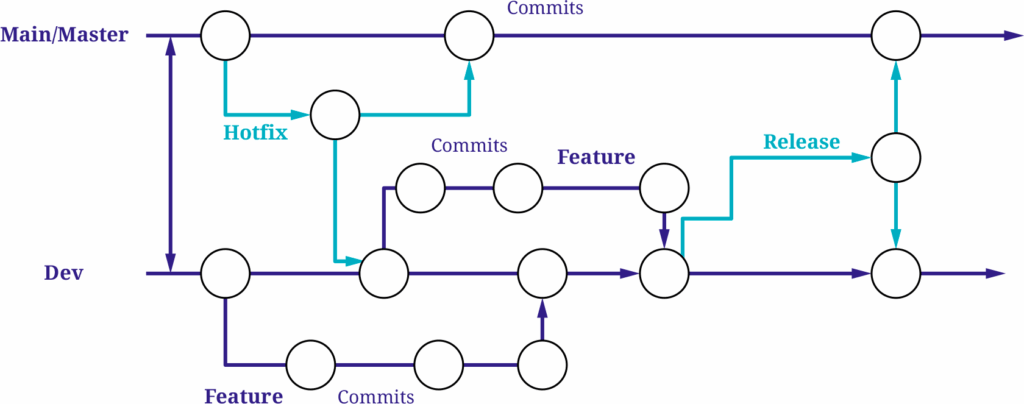
Gitflow branching

GitHub Flow

Compared to Git Flow, the GitHub Flow strategy is significantly leaner. It uses only a single long-lived branch, usually main, and temporary feature branches that are merged via pull requests.

Once all changes on a feature branch are complete and have passed review and various tests, the branch is merged directly into main.

The key advantage of GitHub Flow is its simplicity. There are no separate release or develop branches, and even hotfixes can be handled in short-lived branches. Teams can respond to changes quickly and deploy frequently. This agility is especially effective when supported by a robust CI/CD pipeline. If properly implemented, testing, building, and deployment processes are automated, further improving GitHub Flow’s fast time to market.

Because of its low complexity and minimal coordination overhead, GitHub Flow is also particularly well-suited for smaller teams that value speed and iteration over rigid release planning.

If you’re interested in how such pipelines are structured in practice, our CI/CD pipeline Blog article offers a look at a practical GitHub-based setup using GitHub Actions and dbt. It’s a useful companion piece for understanding the automation layer that supports fast and reliable delivery.

However, this strategy also comes with limitations: it doesn’t support managing multiple parallel versions or complex release planning.

Additionally, it relies heavily on the quality of the CI/CD pipeline.
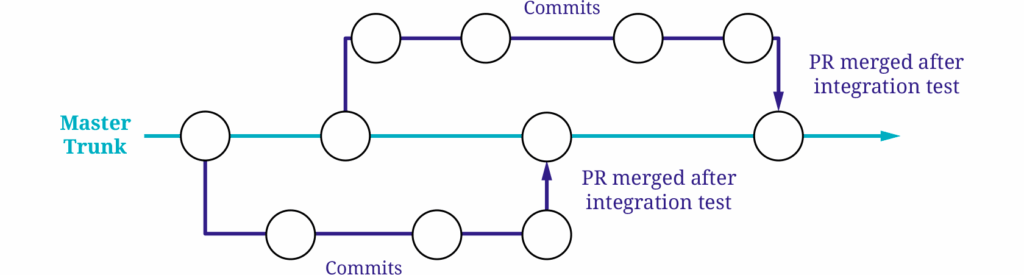
Trunk based branching

Trunk-Based Development

Trunk-Based Development is quite similar to the GitHub Flow strategy, but there are a few key differences.

While it also relies on a single long-lived branch (the trunk, typically main), commits are either made directly to main or via very short-lived feature branches. These feature branches often exist for only a few hours, and it’s common for changes to be merged into main multiple times a day. The goal is to integrate changes as early as possible to avoid conflicts before they even arise.

Because there are no fixed release cycles in Trunk-Based Development, it’s essential to ensure that incomplete features don’t go live prematurely. Feature flags play a central role here, allowing unfinished functionality to be hidden in the production environment until it’s ready.

As with GitHub Flow, a strong CI/CD pipeline is essential. It acts as the main safeguard for quality assurance and enables rapid deployment to the main branch.

Trunk-Based Development is especially effective for teams that are comfortable with rapid iteration and a high level of automation. While it can be used by smaller teams, it truly shines in larger organizations where multiple teams work in parallel and frequent integration is critical to maintaining momentum and consistency.

The benefits of Trunk-Based Development include extremely fast deployments and minimal risk of merge conflicts due to the short-lived nature of branches and continuous integration.

However, similar to GitHub Flow, this strategy heavily depends on the reliability of the CI/CD pipeline. If your team operates in a highly automated DevOps environment, this approach works smoothly. But if that’s not the case, software quality can suffer significantly. The risk is especially high here, as all changes are deployed directly to the main branch.

Conclusion

All three strategies come with their own strengths and weaknesses.

Git Flow is well-suited for larger projects with fixed release cycles, manual QA, and structured approval processes. It offers stability and clear workflows, but also brings significant technical and organizational overhead, making it a heavyweight option that can slow down development and release cycles due to its complexity and synchronization requirements.

GitHub Flow, by contrast, emphasizes speed and simplicity. It’s an excellent fit for smaller teams working on web or SaaS projects that deploy continuously, thanks to its low complexity and quick turnaround. But it relies on a good CI/CD pipeline. If tests are insufficient, faulty code might get deployed automatically.

Many of these risks can be mitigated with proper pipeline design and DevOps experience within the team, ensuring that automation is not just fast but also reliable.

Trunk-Based Development enables the highest release frequency, but only delivers consistent quality if the necessary technical maturity is in place. This makes it ideal for highly automated environments where teams ship many changes every day.

There are always ways to mitigate or minimize the downsides of any branching strategy. Techniques like blue/green or canary deployments, for example, can help reduce the impact of faulty changes and make rollbacks easier.

Stay tuned, we regularly share practical insights and solutions on topics like CI/CD, DevOps patterns, and deployment strategies.
Behind the Branches – Navigating Git Workflows in Modern DevOps

A Man Branching with Visual Studio

Branching Strategies

Branching strategies are one of those topics that rarely get much attention until they suddenly become a problem. Whether it’s drowning in merge conflicts, the headache of implementing and synchronizing hotfixes across multiple branches, or a feature freeze caused by insufficient quality assurance, your repository and branching structure can have a major impact on day-to-day development.

But what branching strategies actually exist, and what are their pros and cons? Which approach allows you to deploy changes most quickly? And how can you maintain high software quality despite frequent releases?

In this article, we’ll provide a structured overview of common branching strategies and typical challenges developers face when using them.

Navigating Git Workflows in Modern DevOps

This webinar offers a clear overview of common approaches and how they impact CI/CD, code quality, and maintainability. Beyond theory, we’ll dive into practical challenges and real-world issues teams face every day. Register now for our free webinar on September 16th, 2025!

Watch Webinar Recording

Why Are Branching Strategies Relevant?

Branching models reflect the organization, release culture, and technical maturity of a project. There is no single “correct” strategy that fits every project. Choosing the right one depends heavily on the project’s context. Some of the most important questions to consider when selecting a branching strategy include:

  • Does the team work in fixed sprint or release cycles, or is code deployed continuously?
  • How many developers are working simultaneously on the same codebase?
  • What is the quality of your CI/CD pipeline? Does every change need a manual review, even if the pipeline passes, or can it be deployed automatically?

Depending on the answers to these questions, a simple or more complex branching strategy may be appropriate.

Comparison of Common Strategies

Git Flow

The Git Flow strategy was originally developed for traditional software projects with planned release cycles. Its long-lived main branches are “main” (or “master”) and “dev”.

In addition, it introduces several short-lived branches:

Feature branches

New features are developed in separate feature branches, which are merged into the develop branch once completed.

Hotfix branches

If a critical bug occurs in the production environment (i.e., on the main branch), a hotfix branch is created from main to address the issue. Once the fix is implemented and pushed to the hotfix branch, it is merged into both main and develop to ensure the bug is resolved in both branches.

Release branches

When a release is approaching, a release branch is created from develop, containing all features added since the last release. This branch is then used for final QA testing, bug fixing, and versioning. Once the release is approved, the release branch is merged into both main and develop.


The main advantage of Git Flow is its clear structure. Even in larger teams with many developers and therefore multiple concurrent feature branches, it’s easy to track which version is in what state. The strategy supports parallel development very well due to its structured branching model.

However, the downside is the organizational and technical overhead. The large number of branches and merges can lead to conflicts and divergence over time, especially with long-lived release and hotfix branches. A particular challenge arises when keeping branches in sync. Hotfixes created from main need to be merged back into main and dev, and changes made in release branches, which originate from dev, must eventually be merged into both main and dev, as shown in the diagram. These synchronization steps often introduce additional effort and increase the risk of conflicts or inconsistencies, especially when multiple streams of work are active in parallel.

Additionally, the path a feature must take, from a feature branch to develop, to a release branch, and finally to main, can slow down the deployment process.

While a solid CI/CD pipeline can help automate and streamline parts of this workflow, Git Flow does not rely on automation to function. This makes it especially suitable for teams with more manual QA processes or limited automation infrastructure.

Gitflow branching

GitHub Flow

Compared to Git Flow, the GitHub Flow strategy is significantly leaner. It uses only a single long-lived branch, usually main, and temporary feature branches that are merged via pull requests.

Once all changes on a feature branch are complete and have passed review and various tests, the branch is merged directly into main.

The key advantage of GitHub Flow is its simplicity. There are no separate release or develop branches, and even hotfixes can be handled in short-lived branches. Teams can respond to changes quickly and deploy frequently. This agility is especially effective when supported by a robust CI/CD pipeline. If properly implemented, testing, building, and deployment processes are automated, further improving GitHub Flow’s fast time to market.

Because of its low complexity and minimal coordination overhead, GitHub Flow is also particularly well-suited for smaller teams that value speed and iteration over rigid release planning.

If you’re interested in how such pipelines are structured in practice, our CI/CD pipeline Blog article offers a look at a practical GitHub-based setup using GitHub Actions and dbt. It’s a useful companion piece for understanding the automation layer that supports fast and reliable delivery.

However, this strategy also comes with limitations: it doesn’t support managing multiple parallel versions or complex release planning.

Additionally, it relies heavily on the quality of the CI/CD pipeline.

Trunk based branching

Trunk-Based Development

Trunk-Based Development is quite similar to the GitHub Flow strategy, but there are a few key differences.

While it also relies on a single long-lived branch (the trunk, typically main), commits are either made directly to main or via very short-lived feature branches. These feature branches often exist for only a few hours, and it’s common for changes to be merged into main multiple times a day. The goal is to integrate changes as early as possible to avoid conflicts before they even arise.

Because there are no fixed release cycles in Trunk-Based Development, it’s essential to ensure that incomplete features don’t go live prematurely. Feature flags play a central role here, allowing unfinished functionality to be hidden in the production environment until it’s ready.

As with GitHub Flow, a strong CI/CD pipeline is essential. It acts as the main safeguard for quality assurance and enables rapid deployment to the main branch.

Trunk-Based Development is especially effective for teams that are comfortable with rapid iteration and a high level of automation. While it can be used by smaller teams, it truly shines in larger organizations where multiple teams work in parallel and frequent integration is critical to maintaining momentum and consistency.

The benefits of Trunk-Based Development include extremely fast deployments and minimal risk of merge conflicts due to the short-lived nature of branches and continuous integration.

However, similar to GitHub Flow, this strategy heavily depends on the reliability of the CI/CD pipeline. If your team operates in a highly automated DevOps environment, this approach works smoothly. But if that’s not the case, software quality can suffer significantly. The risk is especially high here, as all changes are deployed directly to the main branch.

Conclusion

All three strategies come with their own strengths and weaknesses.

Git Flow is well-suited for larger projects with fixed release cycles, manual QA, and structured approval processes. It offers stability and clear workflows, but also brings significant technical and organizational overhead, making it a heavyweight option that can slow down development and release cycles due to its complexity and synchronization requirements.

GitHub Flow, by contrast, emphasizes speed and simplicity. It’s an excellent fit for smaller teams working on web or SaaS projects that deploy continuously, thanks to its low complexity and quick turnaround. But it relies on a good CI/CD pipeline. If tests are insufficient, faulty code might get deployed automatically.

Many of these risks can be mitigated with proper pipeline design and DevOps experience within the team, ensuring that automation is not just fast but also reliable.

Trunk-Based Development enables the highest release frequency, but only delivers consistent quality if the necessary technical maturity is in place. This makes it ideal for highly automated environments where teams ship many changes every day.

There are always ways to mitigate or minimize the downsides of any branching strategy. Techniques like blue/green or canary deployments, for example, can help reduce the impact of faulty changes and make rollbacks easier.

Stay tuned, we regularly share practical insights and solutions on topics like CI/CD, DevOps patterns, and deployment strategies.
Unlock the Intelligence Layer: LLMs in Data Warehousing and the Future of Your Data

Natural Language AI Model

“Stop writing complex SQL, start talking to your data?”

This provocative question highlights a growing shift in how we interact with data. For years, getting answers from a Data Warehouse meant writing SQL queries or relying on pre-built dashboards.

For many organizations, their data platforms remain underutilized because accessing insights still requires writing code or navigating complex dashboards. It’s time to go beyond static reports and unlock a true intelligence layer on top of your data warehouse. Recent advances in Large Language Models (LLMs) and Natural Language Processing (NLP) are making data warehouses smarter, faster, and easier to use for everyone. In this article, we’ll explore how LLMs can transform the way you interact with your data – from using plain English queries instead of SQL, to AI-driven discovery of hidden insights, to enriching your data pipelines – and why this shift represents the future of data analytics.

Unlock the Intelligence Layer: LLMs in Data Warehousing and the Future of your Data

Unlock your data warehouse’s full potential! This webinar reveals how Large Language Models and Natural Language Processing are transforming data interaction, empowering everyone to effortlessly translate plain language into SQL, enable AI-driven data discovery, and deliver actionable insights to every stakeholder. Register for our free webinar, August 12th, 2025!

Watch Webinar Recording

From Complex SQL to Conversational Queries

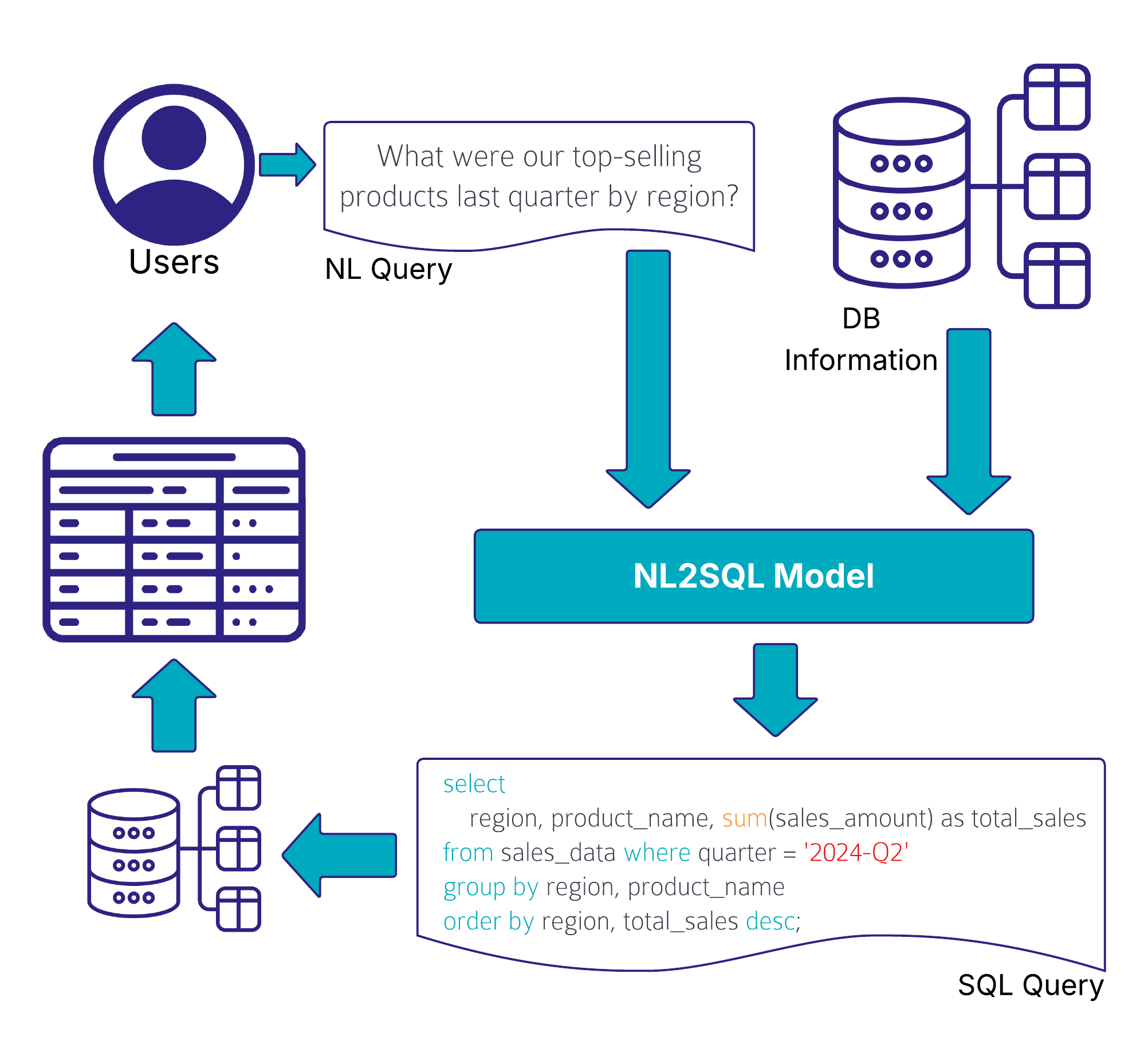
Business users often depend on data engineers or analysts to fetch answers, creating bottlenecks in decision-making. Even data professionals themselves spend considerable time writing and optimizing SQL, rather than interpreting results. What if anyone could simply ask the data warehouse a question in plain language and get the answer? This is the promise of LLMs as an “intelligence layer”, a layer that bridges complex datasets and human comprehension. Advanced LLMs can understand a user’s question or request and generate the appropriate SQL queries on the fly.

This technology (often called Text-to-SQL or Natural-Language-to-SQL or NL2SQL) has rapidly evolved and major technology players have already taken note. For example, Databricks introduced a Natural Language Query feature (LakehouseIQ) to let users ask questions of their Lakehouse, and Snowflake is also exploring LLM-driven query capabilities.

Imagine asking your data warehouse in plain English: “What were our top-selling products last quarter by region?”. This text input is passed into a LLM, often enriched by company-specific data via RAG and then the system translates that into a correct, optimized SQL query that retrieves the answer.

Natural Language AI Model

Of course, translating natural language to SQL at an enterprise scale isn’t trivial. Complex schemas, ambiguous user input, and security considerations mean the LLM has to be both smart and careful. Uber has built such an AI system that works on an enterprise scale level.

Uber’s QueryGPT is an NL2SQL system that uses a multi-step, RAG-based pipeline combining LLMs with retrieval and agent modules. It fetches context via similarity search over a vector database of example queries and schema information for SQL generation. To manage Uber’s vast data ecosystem, QueryGPT employs specialized agents:

  • an Intent Agent classifies requests by business domain
  • a Table Agent suggests tables for the query
  • a Column Prune Agent trims irrelevant columns to reduce prompt length. The LLM then produces the SQL query and an explanation.

This layered design allows QueryGPT to handle large schemas and reliably generate complex multi-table queries. It’s a hybrid architecture where multiple transformer calls specialize in sub-tasks, enabling scalable, accurate NL2SQL as a production service, saving thousands of Uber employees significant time by mid-2024.

AI-Augmented Data Discovery and Insights

Beyond simply fetching results for user queries, LLMs can augment data discovery by revealing insights that users might not have explicitly asked for. Traditional dashboards show you what is happening, but a smart LLM-based system can tell you why it’s happening and highlight patterns you might not notice. This is often called augmented analytics – using AI to automatically find important correlations, trends, outliers, and drivers in your data.

LLMs excel at interpreting data outputs and providing additional context. For example, rather than just displaying a chart or a table, an LLM can generate a written summary pointing out key trends or anomalies. They can explain which metrics are up or down and suggest potential reasons (for instance, detecting that “conversion rates dipped in July, possibly due to seasonality or inventory issues”), enabling quicker and more informed decision-making.

Another area where LLMs can significantly reduce manual effort is in the creation and maintenance of data catalogs. Documenting data models, table structures, and especially individual column descriptions is often time-consuming and easily skipped due to missing resources, despite being crucial for an effective use and accessibility of the data. LLMs can automate large parts of this process by generating descriptions based on data profiling, SQL logic, naming conventions, and metadata.

dbt Cloud has recently released their dbt Copilot AI Agent that supports the developer in various ways, for example by letting the AI analyzing the SQL code and schema metadata to automatically generate model and column descriptions.

LLMs in Your Data Pipeline: Enrichment and Efficiency

LLMs don’t just enhance how users interact with the Data Warehouse; they can also improve the data itself and the efficiency of data engineering processes. In modern ELT (Extract-Load-Transform) pipelines, a lot of time is spent cleaning, enriching, and preparing data for analysis. Here, LLMs offer new tools to automate and augment these steps.

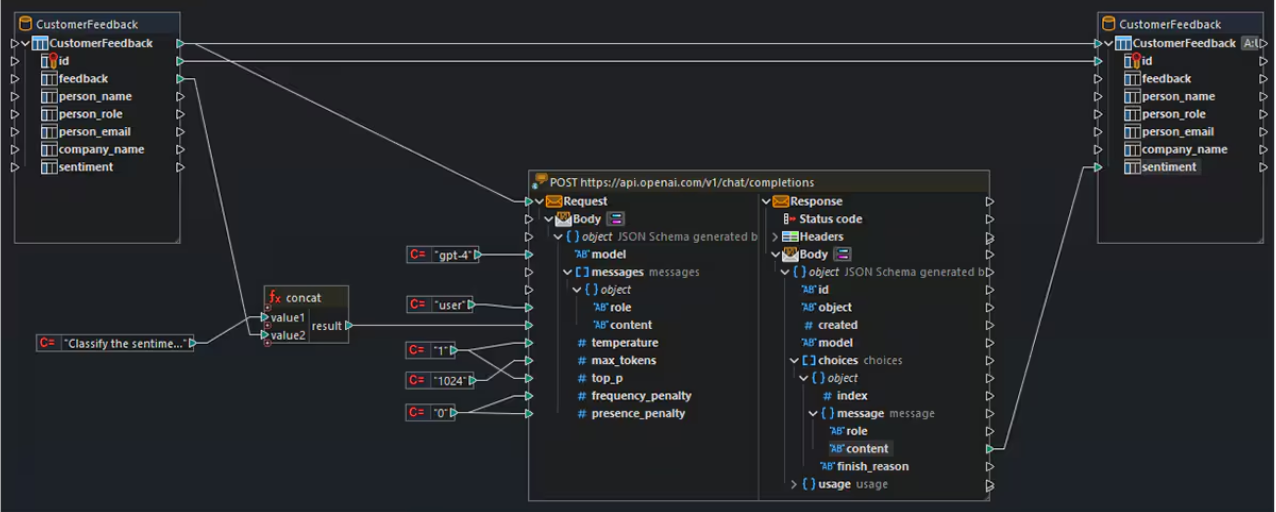
One promising use case is the semantic enrichment of data. Large Language Models have absorbed a vast amount of world knowledge and language patterns, and they can use that to fill gaps or add context to your raw data. For example, imagine you have a dataset of customer feedback where each entry is a text comment. An LLM could automatically classify the sentiment of each comment (positive/negative), extract key themes, or even generate a summary of common issues. In this way, unstructured data becomes structured insights without manual effort. The image below illustrates how an LLM is integrated into a data pipeline: text inputs from a CustomerFeedback table are passed to an OpenAI API endpoint, where the model returns structured sentiment labels that are then stored back in the database.

Large Language Models Sentiment Analysis

In a practical case study, LLMs were used to enrich an academic dataset by inferring missing attributes (like guessing a person’s gender from their name with high accuracy), which outperformed dedicated API services. This showcases how LLMs can bring external knowledge and reasoning to enhance your data.

Another area is metadata enrichment and semantic enrichment of unstructured data. Enterprise data is often filled with cryptic column names and jargon that prevents usability. LLMs can intelligently expand abbreviations and annotate fields with business-friendly descriptions. For instance, an LLM-driven catalog might take a column labeled “CUST_ID” and annotate it as “Customer Identifier, unique ID for each customer record”.

LLMs can also assist in the coding and transformation process itself. Data engineers can leverage LLMs to generate boilerplate code or SQL for transformations, document pipeline logic in plain English, or even detect anomalies and data quality issues through pattern analysis. By automating tedious parts of data preparation and providing AI-generated suggestions, LLMs free up engineers to focus on higher-level architecture and problem-solving.

Conclusion

While the promise of an LLM-powered intelligence layer is exciting, it’s important to approach it with a clear strategy. Successful implementation requires considering a few key challenges and best practices. Data quality and governance are more crucial than ever. If your underlying data is inaccurate or poorly structured, the AI’s answers will be unreliable. As the saying goes, “garbage in, garbage out.”

Ensuring clean, well-organized data (and maintaining a robust data governance program) will help the LLM produce meaningful and correct insights. Additionally, organizations may need to fine-tune or configure their LLMs to understand industry-specific terminology or business context. This reduces the chance of the AI misinterpreting what a user asks or generating an incorrect query.

Privacy and security are another important consideration. If your data includes sensitive information, you must ensure that any AI tool accessing it complies with your security requirements. This might involve using self-hosted models or secure APIs, and setting up proper access controls.

The dream of a self-service analytics experience: “just talk to the data and get answers” is quickly becoming a reality. This evolution may redefine roles (enabling analysts and engineers alike to focus on higher-value tasks) and open up analytics to a wider audience than ever before. It’s an exciting time to be a data professional, but also one that demands staying informed and ready to adapt.

– Ole Bause (Scalefree)

Unlock the Intelligence Layer: LLMs in Data Warehousing and the Future of Your Data

Natural Language AI Model

“Stop writing complex SQL, start talking to your data?”

This provocative question highlights a growing shift in how we interact with data. For years, getting answers from a Data Warehouse meant writing SQL queries or relying on pre-built dashboards.

For many organizations, their data platforms remain underutilized because accessing insights still requires writing code or navigating complex dashboards. It’s time to go beyond static reports and unlock a true intelligence layer on top of your data warehouse. Recent advances in Large Language Models (LLMs) and Natural Language Processing (NLP) are making data warehouses smarter, faster, and easier to use for everyone. In this article, we’ll explore how LLMs can transform the way you interact with your data – from using plain English queries instead of SQL, to AI-driven discovery of hidden insights, to enriching your data pipelines – and why this shift represents the future of data analytics.

Unlock the Intelligence Layer: LLMs in Data Warehousing and the Future of your Data

Unlock your data warehouse’s full potential! This webinar reveals how Large Language Models and Natural Language Processing are transforming data interaction, empowering everyone to effortlessly translate plain language into SQL, enable AI-driven data discovery, and deliver actionable insights to every stakeholder. Register for our free webinar, August 12th, 2025!

Watch Webinar Recording

From Complex SQL to Conversational Queries

Business users often depend on data engineers or analysts to fetch answers, creating bottlenecks in decision-making. Even data professionals themselves spend considerable time writing and optimizing SQL, rather than interpreting results. What if anyone could simply ask the data warehouse a question in plain language and get the answer? This is the promise of LLMs as an “intelligence layer”, a layer that bridges complex datasets and human comprehension. Advanced LLMs can understand a user’s question or request and generate the appropriate SQL queries on the fly.

This technology (often called Text-to-SQL or Natural-Language-to-SQL or NL2SQL) has rapidly evolved and major technology players have already taken note. For example, Databricks introduced a Natural Language Query feature (LakehouseIQ) to let users ask questions of their Lakehouse, and Snowflake is also exploring LLM-driven query capabilities.

Imagine asking your data warehouse in plain English: “What were our top-selling products last quarter by region?”. This text input is passed into a LLM, often enriched by company-specific data via RAG and then the system translates that into a correct, optimized SQL query that retrieves the answer.

Natural Language AI Model

Of course, translating natural language to SQL at an enterprise scale isn’t trivial. Complex schemas, ambiguous user input, and security considerations mean the LLM has to be both smart and careful. Uber has built such an AI system that works on an enterprise scale level.

Uber’s QueryGPT is an NL2SQL system that uses a multi-step, RAG-based pipeline combining LLMs with retrieval and agent modules. It fetches context via similarity search over a vector database of example queries and schema information for SQL generation. To manage Uber’s vast data ecosystem, QueryGPT employs specialized agents:

  • an Intent Agent classifies requests by business domain
  • a Table Agent suggests tables for the query
  • a Column Prune Agent trims irrelevant columns to reduce prompt length. The LLM then produces the SQL query and an explanation.

This layered design allows QueryGPT to handle large schemas and reliably generate complex multi-table queries. It’s a hybrid architecture where multiple transformer calls specialize in sub-tasks, enabling scalable, accurate NL2SQL as a production service, saving thousands of Uber employees significant time by mid-2024.

AI-Augmented Data Discovery and Insights

Beyond simply fetching results for user queries, LLMs can augment data discovery by revealing insights that users might not have explicitly asked for. Traditional dashboards show you what is happening, but a smart LLM-based system can tell you why it’s happening and highlight patterns you might not notice. This is often called augmented analytics – using AI to automatically find important correlations, trends, outliers, and drivers in your data.

LLMs excel at interpreting data outputs and providing additional context. For example, rather than just displaying a chart or a table, an LLM can generate a written summary pointing out key trends or anomalies. They can explain which metrics are up or down and suggest potential reasons (for instance, detecting that “conversion rates dipped in July, possibly due to seasonality or inventory issues”), enabling quicker and more informed decision-making.

Another area where LLMs can significantly reduce manual effort is in the creation and maintenance of data catalogs. Documenting data models, table structures, and especially individual column descriptions is often time-consuming and easily skipped due to missing resources, despite being crucial for an effective use and accessibility of the data. LLMs can automate large parts of this process by generating descriptions based on data profiling, SQL logic, naming conventions, and metadata.

dbt Cloud has recently released their dbt Copilot AI Agent that supports the developer in various ways, for example by letting the AI analyzing the SQL code and schema metadata to automatically generate model and column descriptions.

LLMs in Your Data Pipeline: Enrichment and Efficiency

LLMs don’t just enhance how users interact with the Data Warehouse; they can also improve the data itself and the efficiency of data engineering processes. In modern ELT (Extract-Load-Transform) pipelines, a lot of time is spent cleaning, enriching, and preparing data for analysis. Here, LLMs offer new tools to automate and augment these steps.

One promising use case is the semantic enrichment of data. Large Language Models have absorbed a vast amount of world knowledge and language patterns, and they can use that to fill gaps or add context to your raw data. For example, imagine you have a dataset of customer feedback where each entry is a text comment. An LLM could automatically classify the sentiment of each comment (positive/negative), extract key themes, or even generate a summary of common issues. In this way, unstructured data becomes structured insights without manual effort. The image below illustrates how an LLM is integrated into a data pipeline: text inputs from a CustomerFeedback table are passed to an OpenAI API endpoint, where the model returns structured sentiment labels that are then stored back in the database.

Large Language Models Sentiment Analysis

In a practical case study, LLMs were used to enrich an academic dataset by inferring missing attributes (like guessing a person’s gender from their name with high accuracy), which outperformed dedicated API services. This showcases how LLMs can bring external knowledge and reasoning to enhance your data.

Another area is metadata enrichment and semantic enrichment of unstructured data. Enterprise data is often filled with cryptic column names and jargon that prevents usability. LLMs can intelligently expand abbreviations and annotate fields with business-friendly descriptions. For instance, an LLM-driven catalog might take a column labeled “CUST_ID” and annotate it as “Customer Identifier, unique ID for each customer record”.

LLMs can also assist in the coding and transformation process itself. Data engineers can leverage LLMs to generate boilerplate code or SQL for transformations, document pipeline logic in plain English, or even detect anomalies and data quality issues through pattern analysis. By automating tedious parts of data preparation and providing AI-generated suggestions, LLMs free up engineers to focus on higher-level architecture and problem-solving.

Conclusion

While the promise of an LLM-powered intelligence layer is exciting, it’s important to approach it with a clear strategy. Successful implementation requires considering a few key challenges and best practices. Data quality and governance are more crucial than ever. If your underlying data is inaccurate or poorly structured, the AI’s answers will be unreliable. As the saying goes, “garbage in, garbage out.”

Ensuring clean, well-organized data (and maintaining a robust data governance program) will help the LLM produce meaningful and correct insights. Additionally, organizations may need to fine-tune or configure their LLMs to understand industry-specific terminology or business context. This reduces the chance of the AI misinterpreting what a user asks or generating an incorrect query.

Privacy and security are another important consideration. If your data includes sensitive information, you must ensure that any AI tool accessing it complies with your security requirements. This might involve using self-hosted models or secure APIs, and setting up proper access controls.

The dream of a self-service analytics experience: “just talk to the data and get answers” is quickly becoming a reality. This evolution may redefine roles (enabling analysts and engineers alike to focus on higher-value tasks) and open up analytics to a wider audience than ever before. It’s an exciting time to be a data professional, but also one that demands staying informed and ready to adapt.

– Ole Bause (Scalefree)

Chatbot Implementation Using Retrieval-Augmented Generation

Chatbot RAG Retrieval Phase

In today’s AI-driven world, businesses are looking for smarter, cost-effective chatbot solutions that enhance customer interactions and streamline internal operations. While traditional chatbot models often struggle with outdated or generic responses, modern advancements have opened the door to more dynamic and intelligent systems.

This article is for business leaders, developers, and AI enthusiasts looking to implement smarter chatbot solutions. It explores Retrieval-Augmented Generation (RAG), a game-changing approach that enhances chatbot performance by retrieving relevant information in real time. By the end, you’ll not only understand why RAG is so powerful but also how to implement it effectively to build scalable, cost-efficient, and context-aware chatbots using Google Cloud Platform Services.

Implementing Production-Ready RAG Chatbots: Enhancing Information Retrieval with AI

Join our webinar for a practical guide to building and deploying powerful, RAG-driven chatbot solutions. We’ll show you how to leverage essential Google Cloud services for effective implementation, enabling your chatbot to deliver more accurate and relevant responses. Register for our free webinar, July 15th, 2025!

Watch Webinar Recording

The Challenge of Deploying Chatbots

Chatbots are widely used in businesses to automate customer support and streamline internal operations. While large language models (LLMs) have improved chatbot capabilities by generating human-like responses, they come with significant challenges. LLMs require costly fine-tuning, extensive resource usage, and ongoing maintenance, making them impractical for many companies. Additionally, fine-tuned models quickly become outdated, requiring frequent retraining to stay relevant.

An alternative approach is Retrieval-Augmented Generation, which dynamically retrieves relevant information in real time, rather than relying solely on pre-trained data. This allows chatbots to stay up-to-date, reduce costs, and improve accuracy, making RAG a powerful solution for businesses looking for intelligent and scalable AI-driven chatbots without the high expenses of fine-tuning or pre-training.

RAG Architecture

RAG is revolutionizing the way chatbots interact and provide information. But how does this powerful architecture actually work? The magic lies in its two distinct phases: The Preparation Phase, where the knowledge base is built, and the Retrieval Phase, where user queries are processed and relevant information is retrieved to generate a response. Each phase plays a crucial role in creating an intelligent and responsive system. Let’s explore how RAG works in detail, starting with the preparation phase.

Preparation Phase

RAG Chatbot Architecture General Preparation Phase

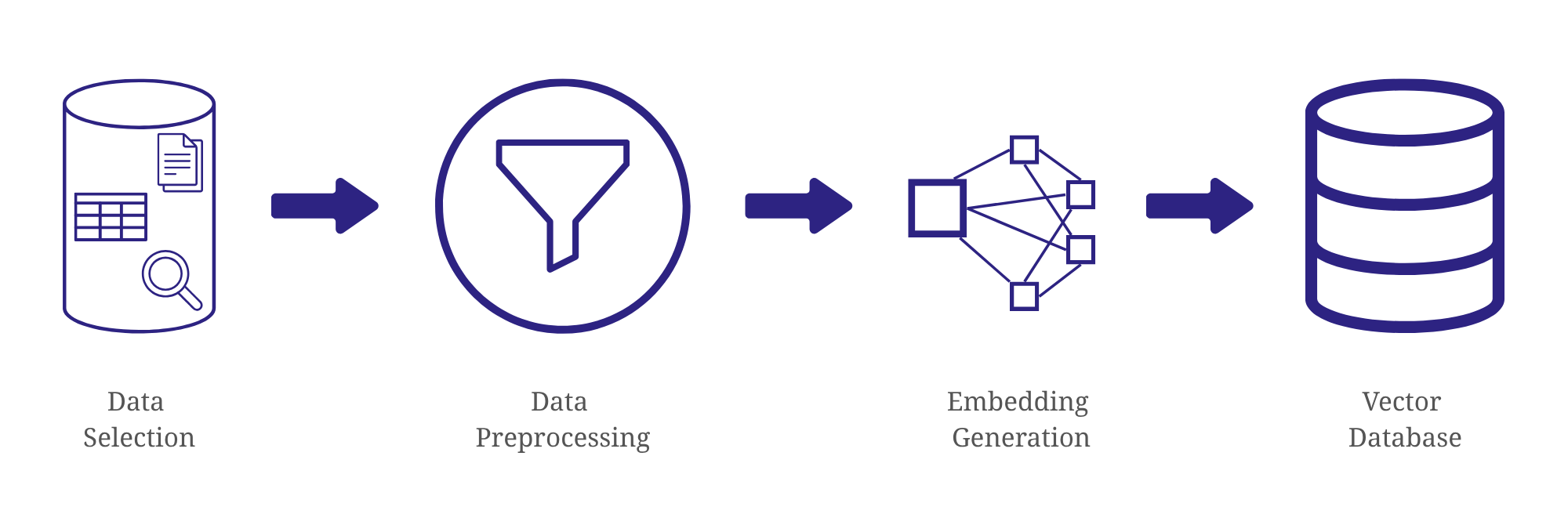
Data Selection: The preparation begins by selecting the appropriate data for the chatbot’s knowledge base. This typically involves choosing organized sources like databases, which contain the structured information necessary for the chatbot to function effectively.

Data Preprocessing: To prepare the raw data for optimal use in a RAG system, preprocessing is essential. This stage serves three primary purposes: enabling efficient retrieval, ensuring compatibility with the generative AI model, and optimizing for effective embedding generation. Efficient retrieval hinges on assigning unique identifiers, such as IDs, to each data element. This allows the system to quickly locate and access specific pieces of information. To enhance both the generative AI model’s understanding and the quality of embeddings, techniques such as flattening tables, tokenization, text cleaning, stemming, lemmatization, stop word removal, and data type conversion can be employed. These techniques refine the data’s structure and content, making it easier for the generative AI model to process and understand, while also optimizing the data for capturing semantic meaning and relationships in the embeddings.

Embedding Generation: With the data now preprocessed and refined, it’s ready to be transformed into a format suitable for efficient retrieval. This is where embedding generation comes in. This step involves converting the preprocessed data into numerical vectors known as embeddings using a specifically trained embedding model. The embeddings capture the semantic meaning of the data, encoding relationships between words, concepts, and ideas, which enables efficient retrieval of relevant information. The specific embedding model used will depend on the nature of the data and the requirements of the RAG system.

What is an Embedding?

In natural language processing, an embedding is a numerical representation of a word, phrase, or document that captures its meaning. These numerical vectors, which can range from a few hundred to many thousand dimensions, are designed so that words or documents with similar meanings have embeddings that are close together in the vector space.

For example, in an embedding space, the word “cat” would be located much closer to the word “lion” (another feline) than to the word “car” (an unrelated object). Meaning that even if two words were nearly identical in spelling but had vastly different meanings, their embeddings would be distant. This spatial arrangement reflects the semantic relationship between the words.

This allows AI systems to understand relationships between words and concepts, enabling them to perform tasks such as identifying similar documents. Embeddings are a fundamental building block for many AI applications, including RAG.

Saving the Embeddings in a Vector Database: The final step in the preparation phase is to store the generated embeddings in a specialized database designed for handling vector data. This is crucial because traditional databases aren’t optimized for storing or searching high-dimensional vectors. Saving the embeddings in a vector database ensures that the RAG system can quickly pinpoint the most relevant information in the knowledge base when responding to user queries.

Now looking at Data Vault’s architecture, we see that to some extent it is quite similar to what Databricks proposes: a multi-layer solution composed of a Staging layer, a Raw Data Vault and a Business Vault, followed by the domain-specific information marts. In the image below, we can see an example of a Data Vault architecture.

Retrieval Phase

With the knowledge base now prepared and ready for efficient retrieval, let’s explore how the RAG system interacts with users and generates responses in real-time.

Chatbot RAG Retrieval Phase
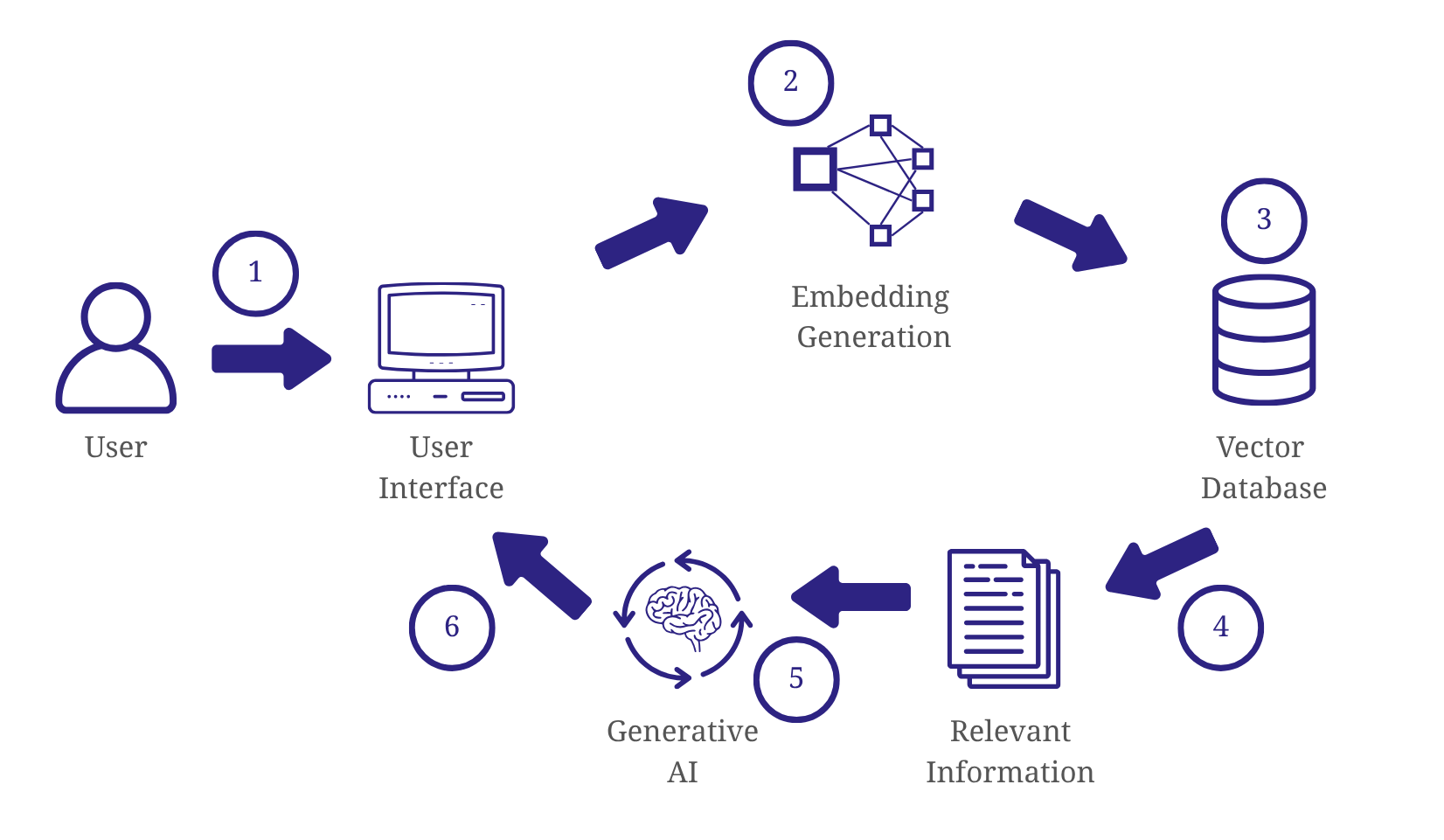
  1. User Interaction: The process begins with a user interacting with the chatbot through a user interface. This interaction could be a chat window, or any other platform that allows users to input queries.
  2. Embedding Generation: The user query is then converted into an embedding using the same embedding model that was used to process the knowledge base during the preparation phase. Consistency is vital because different embedding models might produce different numerical representations, hindering the similarity search process.
  3. Similarity Search and Retrieval: The query’s embedding is used to perform a similarity search within the same vector database that contains the knowledge base embeddings. This search identifies the most semantically similar embeddings, returning their corresponding IDs.
  4. Retrieve relevant Information: The IDs retrieved from the similarity search are then used to query the preprocessed data from the knowledge base. This lookup retrieves the corresponding documents in their preprocessed text form, providing the generative AI model with the necessary context for generating a response.
  5. Generative AI: The retrieved information, along with the original user query, is passed to a generative AI model. This model uses its knowledge to generate a relevant response to the user’s query. The generative process allows RAG systems to provide answers that are more than just basic information retrieval.
  6. Delivering the Response: Finally, the generated response is delivered back to the user through the user interface. The response could be in the form of text displayed in a chat window or a spoken response from a voice assistant.

Implementing a RAG-Based Chatbot: A Practical Example

Now that we’ve explored the underlying architecture of RAG, let’s see how you can implement a RAG-based chatbot using services from the Google Cloud Platform. This example focuses on building an internal knowledge chatbot that can answer employee questions based on internal documents from a knowledge platform.

Data Preparation

The foundation of any effective RAG system is well-prepared data. This initial phase focuses on transforming your raw knowledge into a searchable format, ensuring documents are ready for efficient retrieval.

Chatbot RAG Data Preparation in Google
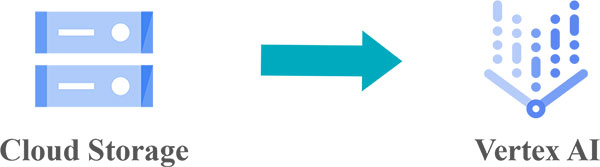
  • Data Selection and Preprocessing: First, you’ll need to gather the relevant internal documents, preprocess them and save the data in a data platform like Google Cloud Storage.
  • Embedding Generation: Once the preprocessed data is securely stored, Google Cloud Vertex AI is utilized to transform this data. Vertex AI extracts the textual content and converts it into high-dimensional vector embeddings, creating numerical representations that capture the semantic meaning of your documents. You can choose from various pre-trained embedding models or fine-tune your own model based on your specific needs.
  • Vector Database: With the embeddings successfully generated, Google Cloud Vertex AI Vector Search then serves as the vector database. It efficiently stores these high-dimensional embeddings and is designed to enable rapid and accurate similarity searches during the retrieval phase.

Retrieval Architecture

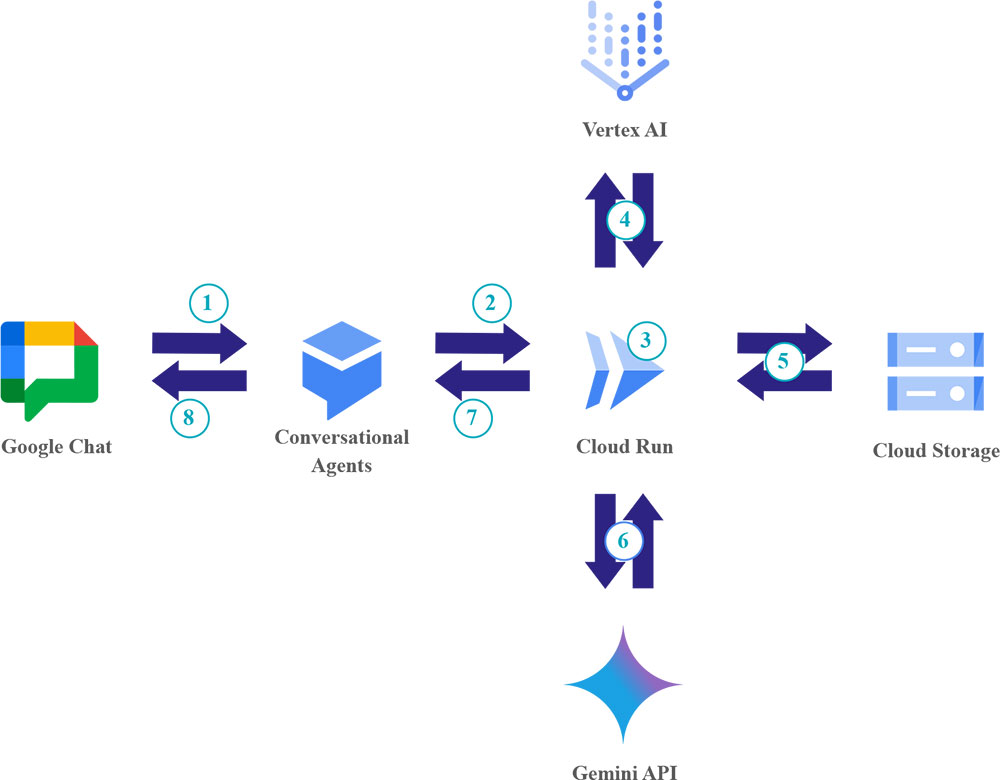
This section outlines the Retrieval-Augmented Generation architecture of our Google Chat chatbot. It describes the flow of a user’s query through various Google Cloud Platform services, from initial submission to the delivery of a generated response, creating a robust and intelligent conversational experience.

RAG Pipeline
  1. User Interaction: The user begins by asking a question within Google Chat. Google Chat serves as the user interface, directing the query to the Conversational Agents platform.
  2. Request Orchestration: Conversational Agents receives the user’s input. It then triggers a webhook call, sending the user’s query to our RAG orchestrator service, which is hosted on Google Cloud Run.
  3. User Query Embedding: From this point, the Google Cloud Run service takes over as the central orchestrator of the RAG pipeline. It starts by processing the user’s query, generating a high-dimensional vector embedding of it using the same embedding model that was utilized during the data preparation.
  4. Information Discovery: The generated user query embedding is then transmitted from Cloud Run to Vertex AI Vector Search. Vertex AI performs an efficient similarity search, identifying and returning the ID(s) of semantically similar documents from the knowledge base based on the provided embedding.
  5. Relevant Information Retrieval: With the identified document ID(s) obtained from Vertex AI Vector Search (these IDs precisely match our preprocessed documents that are most relevant to the user’s query), the Cloud Run service accesses Google Cloud Storage. From Cloud Storage, the full text content of these matched knowledge base pages is fetched. These documents provide the essential context required for accurate response generation.
  6. Generative AI Response: The Cloud Run service then combines the original user query with the retrieved document content into a carefully constructed prompt. This comprehensive prompt is sent to the Gemini API, leveraging Google’s large language model to generate a natural language answer.
  7. Response Delivery: The generated answer from the Gemini API is received by the Cloud Run service. The Cloud Run service formats this response and sends it back to Conversational Agents.
  8. Final User Delivery: Conversational Agents receives the generated answer and seamlessly relays it back to the user within Google Chat, completing the interaction.

This example demonstrates how you can leverage GCP services to implement a RAG-based chatbot for internal knowledge sharing. By combining data preparation, embedding generation, similarity search, and generative AI, you can create a powerful tool that empowers employees with quick and easy access to relevant information.

– Tim Voßmerbäumer (Scalefree)

Chatbot Implementation Using Retrieval-Augmented Generation

Chatbot RAG Retrieval Phase

In today’s AI-driven world, businesses are looking for smarter, cost-effective chatbot solutions that enhance customer interactions and streamline internal operations. While traditional chatbot models often struggle with outdated or generic responses, modern advancements have opened the door to more dynamic and intelligent systems.

This article is for business leaders, developers, and AI enthusiasts looking to implement smarter chatbot solutions. It explores Retrieval-Augmented Generation (RAG), a game-changing approach that enhances chatbot performance by retrieving relevant information in real time. By the end, you’ll not only understand why RAG is so powerful but also how to implement it effectively to build scalable, cost-efficient, and context-aware chatbots using Google Cloud Platform Services.

Implementing Production-Ready RAG Chatbots: Enhancing Information Retrieval with AI

Join our webinar for a practical guide to building and deploying powerful, RAG-driven chatbot solutions. We’ll show you how to leverage essential Google Cloud services for effective implementation, enabling your chatbot to deliver more accurate and relevant responses. Register for our free webinar, July 15th, 2025!

Watch Webinar Recording

The Challenge of Deploying Chatbots

Chatbots are widely used in businesses to automate customer support and streamline internal operations. While large language models (LLMs) have improved chatbot capabilities by generating human-like responses, they come with significant challenges. LLMs require costly fine-tuning, extensive resource usage, and ongoing maintenance, making them impractical for many companies. Additionally, fine-tuned models quickly become outdated, requiring frequent retraining to stay relevant.

An alternative approach is Retrieval-Augmented Generation, which dynamically retrieves relevant information in real time, rather than relying solely on pre-trained data. This allows chatbots to stay up-to-date, reduce costs, and improve accuracy, making RAG a powerful solution for businesses looking for intelligent and scalable AI-driven chatbots without the high expenses of fine-tuning or pre-training.

RAG Architecture

RAG is revolutionizing the way chatbots interact and provide information. But how does this powerful architecture actually work? The magic lies in its two distinct phases: The Preparation Phase, where the knowledge base is built, and the Retrieval Phase, where user queries are processed and relevant information is retrieved to generate a response. Each phase plays a crucial role in creating an intelligent and responsive system. Let’s explore how RAG works in detail, starting with the preparation phase.

Preparation Phase

RAG Chatbot Architecture General Preparation Phase

Data Selection: The preparation begins by selecting the appropriate data for the chatbot’s knowledge base. This typically involves choosing organized sources like databases, which contain the structured information necessary for the chatbot to function effectively.

Data Preprocessing: To prepare the raw data for optimal use in a RAG system, preprocessing is essential. This stage serves three primary purposes: enabling efficient retrieval, ensuring compatibility with the generative AI model, and optimizing for effective embedding generation. Efficient retrieval hinges on assigning unique identifiers, such as IDs, to each data element. This allows the system to quickly locate and access specific pieces of information. To enhance both the generative AI model’s understanding and the quality of embeddings, techniques such as flattening tables, tokenization, text cleaning, stemming, lemmatization, stop word removal, and data type conversion can be employed. These techniques refine the data’s structure and content, making it easier for the generative AI model to process and understand, while also optimizing the data for capturing semantic meaning and relationships in the embeddings.

Embedding Generation: With the data now preprocessed and refined, it’s ready to be transformed into a format suitable for efficient retrieval. This is where embedding generation comes in. This step involves converting the preprocessed data into numerical vectors known as embeddings using a specifically trained embedding model. The embeddings capture the semantic meaning of the data, encoding relationships between words, concepts, and ideas, which enables efficient retrieval of relevant information. The specific embedding model used will depend on the nature of the data and the requirements of the RAG system.

What is an Embedding?

In natural language processing, an embedding is a numerical representation of a word, phrase, or document that captures its meaning. These numerical vectors, which can range from a few hundred to many thousand dimensions, are designed so that words or documents with similar meanings have embeddings that are close together in the vector space.

For example, in an embedding space, the word “cat” would be located much closer to the word “lion” (another feline) than to the word “car” (an unrelated object). Meaning that even if two words were nearly identical in spelling but had vastly different meanings, their embeddings would be distant. This spatial arrangement reflects the semantic relationship between the words.

This allows AI systems to understand relationships between words and concepts, enabling them to perform tasks such as identifying similar documents. Embeddings are a fundamental building block for many AI applications, including RAG.

Saving the Embeddings in a Vector Database: The final step in the preparation phase is to store the generated embeddings in a specialized database designed for handling vector data. This is crucial because traditional databases aren’t optimized for storing or searching high-dimensional vectors. Saving the embeddings in a vector database ensures that the RAG system can quickly pinpoint the most relevant information in the knowledge base when responding to user queries.

Now looking at Data Vault’s architecture, we see that to some extent it is quite similar to what Databricks proposes: a multi-layer solution composed of a Staging layer, a Raw Data Vault and a Business Vault, followed by the domain-specific information marts. In the image below, we can see an example of a Data Vault architecture.

Retrieval Phase

With the knowledge base now prepared and ready for efficient retrieval, let’s explore how the RAG system interacts with users and generates responses in real-time.

Chatbot RAG Retrieval Phase
  1. User Interaction: The process begins with a user interacting with the chatbot through a user interface. This interaction could be a chat window, or any other platform that allows users to input queries.
  2. Embedding Generation: The user query is then converted into an embedding using the same embedding model that was used to process the knowledge base during the preparation phase. Consistency is vital because different embedding models might produce different numerical representations, hindering the similarity search process.
  3. Similarity Search and Retrieval: The query’s embedding is used to perform a similarity search within the same vector database that contains the knowledge base embeddings. This search identifies the most semantically similar embeddings, returning their corresponding IDs.
  4. Retrieve relevant Information: The IDs retrieved from the similarity search are then used to query the preprocessed data from the knowledge base. This lookup retrieves the corresponding documents in their preprocessed text form, providing the generative AI model with the necessary context for generating a response.
  5. Generative AI: The retrieved information, along with the original user query, is passed to a generative AI model. This model uses its knowledge to generate a relevant response to the user’s query. The generative process allows RAG systems to provide answers that are more than just basic information retrieval.
  6. Delivering the Response: Finally, the generated response is delivered back to the user through the user interface. The response could be in the form of text displayed in a chat window or a spoken response from a voice assistant.

Implementing a RAG-Based Chatbot: A Practical Example

Now that we’ve explored the underlying architecture of RAG, let’s see how you can implement a RAG-based chatbot using services from the Google Cloud Platform. This example focuses on building an internal knowledge chatbot that can answer employee questions based on internal documents from a knowledge platform.

Data Preparation

The foundation of any effective RAG system is well-prepared data. This initial phase focuses on transforming your raw knowledge into a searchable format, ensuring documents are ready for efficient retrieval.

Chatbot RAG Data Preparation in Google
  • Data Selection and Preprocessing: First, you’ll need to gather the relevant internal documents, preprocess them and save the data in a data platform like Google Cloud Storage.
  • Embedding Generation: Once the preprocessed data is securely stored, Google Cloud Vertex AI is utilized to transform this data. Vertex AI extracts the textual content and converts it into high-dimensional vector embeddings, creating numerical representations that capture the semantic meaning of your documents. You can choose from various pre-trained embedding models or fine-tune your own model based on your specific needs.
  • Vector Database: With the embeddings successfully generated, Google Cloud Vertex AI Vector Search then serves as the vector database. It efficiently stores these high-dimensional embeddings and is designed to enable rapid and accurate similarity searches during the retrieval phase.

Retrieval Architecture

This section outlines the Retrieval-Augmented Generation architecture of our Google Chat chatbot. It describes the flow of a user’s query through various Google Cloud Platform services, from initial submission to the delivery of a generated response, creating a robust and intelligent conversational experience.

RAG Pipeline
  1. User Interaction: The user begins by asking a question within Google Chat. Google Chat serves as the user interface, directing the query to the Conversational Agents platform.
  2. Request Orchestration: Conversational Agents receives the user’s input. It then triggers a webhook call, sending the user’s query to our RAG orchestrator service, which is hosted on Google Cloud Run.
  3. User Query Embedding: From this point, the Google Cloud Run service takes over as the central orchestrator of the RAG pipeline. It starts by processing the user’s query, generating a high-dimensional vector embedding of it using the same embedding model that was utilized during the data preparation.
  4. Information Discovery: The generated user query embedding is then transmitted from Cloud Run to Vertex AI Vector Search. Vertex AI performs an efficient similarity search, identifying and returning the ID(s) of semantically similar documents from the knowledge base based on the provided embedding.
  5. Relevant Information Retrieval: With the identified document ID(s) obtained from Vertex AI Vector Search (these IDs precisely match our preprocessed documents that are most relevant to the user’s query), the Cloud Run service accesses Google Cloud Storage. From Cloud Storage, the full text content of these matched knowledge base pages is fetched. These documents provide the essential context required for accurate response generation.
  6. Generative AI Response: The Cloud Run service then combines the original user query with the retrieved document content into a carefully constructed prompt. This comprehensive prompt is sent to the Gemini API, leveraging Google’s large language model to generate a natural language answer.
  7. Response Delivery: The generated answer from the Gemini API is received by the Cloud Run service. The Cloud Run service formats this response and sends it back to Conversational Agents.
  8. Final User Delivery: Conversational Agents receives the generated answer and seamlessly relays it back to the user within Google Chat, completing the interaction.

This example demonstrates how you can leverage GCP services to implement a RAG-based chatbot for internal knowledge sharing. By combining data preparation, embedding generation, similarity search, and generative AI, you can create a powerful tool that empowers employees with quick and easy access to relevant information.

– Tim Voßmerbäumer (Scalefree)

Data Vault on Databricks: Does It Make Sense?

Data Vault and Medallion Architecture

In this article, we will try to explore the practical considerations of implementing Data Vault on Databricks, by analyzing Databricks’ ecosystem and its alignment with Data Vault’s core principles. We will go over the fundamentals of Databricks’ architecture, its compatibility with Data Vault’s layered approach, and how some of Databricks’ features can be leveraged to simplify, optimize, or even replace certain traditional aspects of a Data Vault implementation.

This article aims to provide a strategic perspective on how Databricks can support Data Vault principles such as historization, scalability, auditability, and modular design. We’ll discuss opportunities, such as using Delta Lake for time travel and schema evolution, and challenges, like the performance trade-offs introduced by Data Vault’s high number of joins.

Bridging EDW and Lakehouse: Implementing Data Vault on Databricks

Join us in this webinar as we explore the process of implementing Data Vault on Databricks. We will go over different integration strategies and potential challenges, as well as technical aspects like data modeling, performance considerations, and data governance. Register for our free webinar, June 17th, 2025!

Watch Webinar Recording

Understanding Data Vault 2.0

Data Vault is traditionally defined as a methodology encompassing implementation practices, an architectural framework, and a data modeling approach for building a business intelligence system. However, this article focuses on the architectural and modeling aspects of Data Vault, as these are most relevant topics for the implementation of Data Vault on Databricks.

The main advantage of adopting Data Vault’s architecture and modeling are:

  • Preservation of Historical Integrity and Auditability.
    • Insert-only historization
    • Reconstruction of data source deliveries
    • Simplified Governance and Compliance
  • Flexible and Scalable Architecture Data Model
    • Modular Data Model (Hub & Spoke)
    • Scalable
    • Decoupling of Hard and Soft Business rules
    • Tool Agnosticism

The Databricks Ecosystem

Databricks is a leading platform for data analytics, offering a unified environment for data processing, machine learning, and collaborative data science. Its lakehouse architecture, built on Apache Spark and Delta Lake, combines the flexibility of data lakes with the structure and performance of data warehouses. This approach allows organizations to store all types of data while enabling efficient SQL-based analytics and AI/ML workloads.

For Data Vault implementation, Databricks can be a practical choice. Delta Lake’s ACID compliance and transaction logs ensure data integrity and enable Time Travel for historical analysis. As we will see next, features like Delta Live Tables and Unity Catalog optimize data ingestion, transformation, and governance, making Databricks a compelling platform for implementing Data Vault.

Databricks and Data Vault: Do they work together?

To assess the combination of Databricks and Data Vault, we need to analyze their common ground: architecture and data modeling. Both are designed to handle large scales of volume and data processing, and a successful integration of both relies on understanding how they can complement each other.

Architectural Compatibility

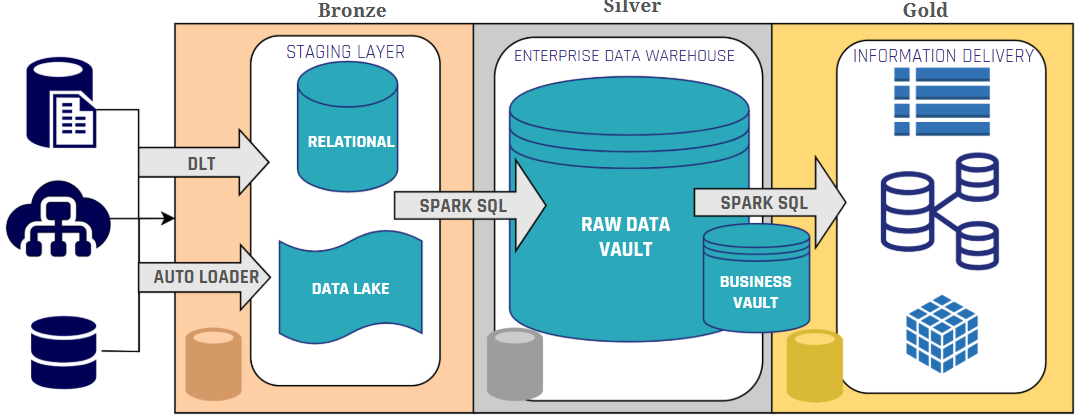
Databricks, built on Apache Spark and Delta Lake, follows the Medallion Architecture, a layered approach designed to structure and refine data. Their Medallion Architecture provides a best practice for managing data within a lakehouse environment, utilizing a three-layered approach (Bronze, Silver, Gold) to progressively structure and refine data. This approach aligns well with Data Vault’s multi-layered architecture (Staging, Raw Data Vault, Business Vault, Information Marts).

Databricks Data Quality Architecture

Image 1: Databricks’ Medallion architecture

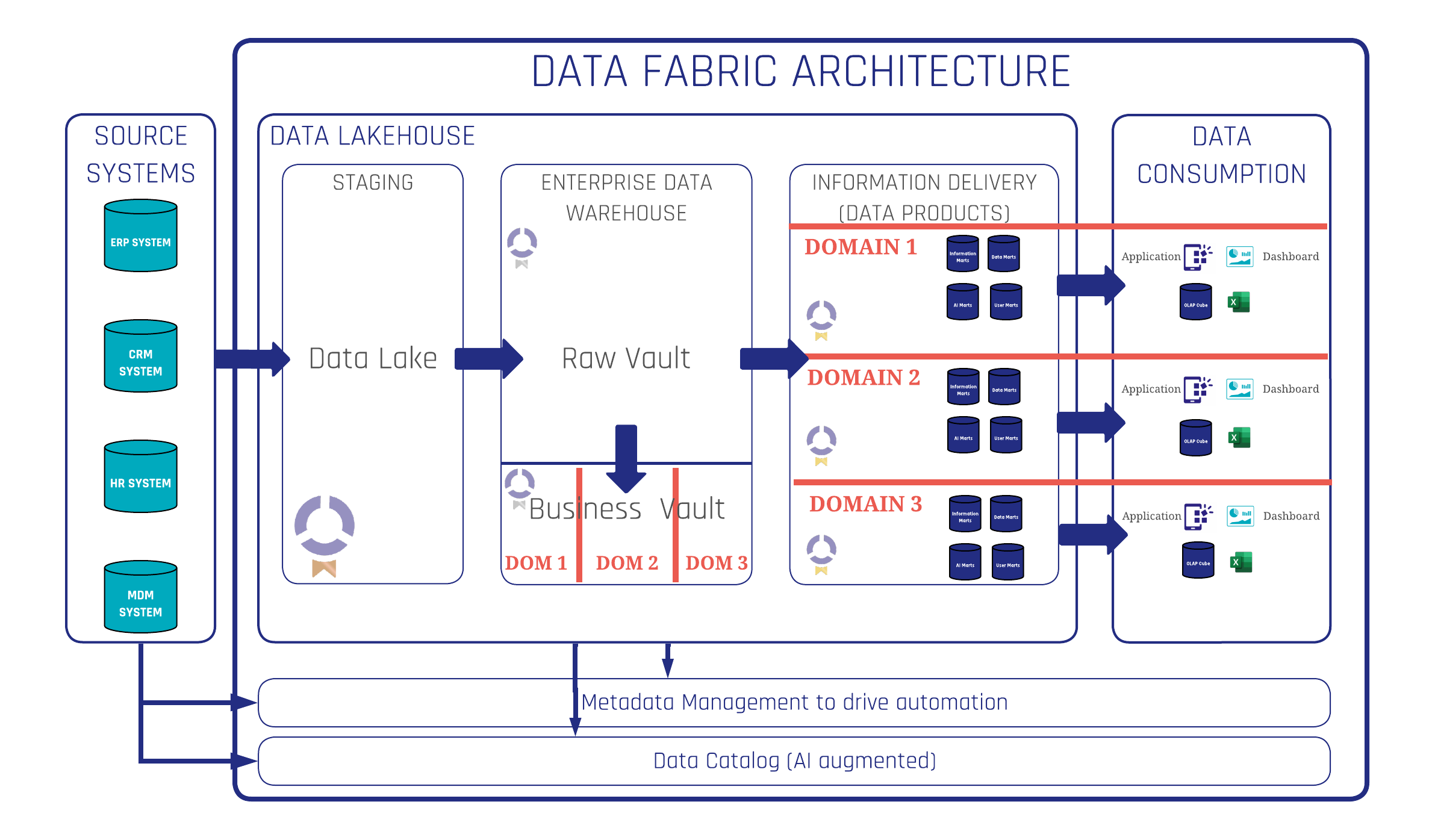
Now looking at Data Vault’s architecture, we see that to some extent it is quite similar to what Databricks proposes: a multi-layer solution composed of a Staging layer, a Raw Data Vault and a Business Vault, followed by the domain-specific information marts. In the image below, we can see an example of a Data Vault architecture.

Data Vault Architecture

Image 2: Data Vault Architecture

Integrating Data Vault with the Medallion Architecture allows for a synergistic approach, as we can see in image 3.

Data Vault and Medallion Architecture

Image 3: Data Vault and Medallion Architecture

The Bronze layer serves the same purpose as Data Vault’s Staging Area, where raw data is ingested from the different sources and stored in a single place. From then on, the Silver layer will store the Raw Data Vault, source tables will be split into hubs, links, and satellites. Here we can already consider some Databricks’ features, such as schema enforcement for integrity; and also Delta Live Tables and Spark SQL to maintain steady loading processes and automate quality checks. The Business Vault, which derives additional business-relevant data structures, sits between Silver and Gold layers, assisting with the information delivery process.

In the Business Vault, Databricks features such as Z-Ordering and data skipping can optimize performance by organizing data more efficiently. Additionally, Spark SQL can be used for aggregations and transformations supported in PIT and Bridge tables. Finally, in the Gold layer, we can start creating our Information Marts with Flat & Wide structures that improve the performance when querying the information out of the Vault.

Privacy and Security

Databricks’ data governance features included in Unity Catalog can optimize Data Vault implementations by simplifying security and privacy controls. Unity Catalog’s fine-grained access control and data masking capabilities can eliminate the need for satellite splits traditionally used to manage sensitive data. Additionally, the lakehouse architecture enables direct data querying, which facilitates compliance with GDPR and data privacy regulations, particularly for responding to data subject access requests (DSAR) and right-to-be-forgotten requests. These data governance features help to simplify the Data Vault model and reduce the final amount of tables in the Vault.

Historization

While both Data Vault and Databricks offer mechanisms for data historization, relying solely on Delta Lake’s Time Travel for historization in a Data Vault implementation on Databricks might not be the best choice. In Databricks, the VACUUM command can permanently delete older data files, potentially removing historical data needed for auditing, lineage analysis and regulatory compliance. Hence, alternative historization methods should be considered, such as maintaining traditional historization with Data Vault’s modelling insert-only approach, or leveraging Databricks’ Change Data Feed to capture a stream of changes made to Delta Lake tables. This ensures a complete and auditable history, even if older data versions are removed by the VACUUM command.

Performance Considerations

When implementing Data Vault on Databricks, performance optimization requires architectural considerations that comprehend the characteristics of both systems. The modular design of Data Vault can create numerous tables with complex join patterns, which can be challenging in Databricks’ Spark environment, since Delta Lake’s column-based Parquet files can struggle with extensive joins. To address this challenge, practitioners should minimize satellite splits (leveraging Databricks’ native security and privacy features instead), implement virtualization in the Business Vault through views, and utilize Point-in-Time and Bridge tables to precompute historical snapshots that reduce join complexity and aid in achieving the target granularity.

For optimal performance, information marts should adopt Flat & Wide structures that prioritize query speed over storage efficiency (an acceptable trade-off given today’s relatively low storage costs). Additional performance gains can be achieved by strategically applying Delta Lake features like Z-Ordering and data skipping to enhance the information delivery process. The decision between views and fully materialized information marts is also an aspect to consider; while views reduce redundancy and simplify management, materialized marts with denormalized tables provide substantial performance benefits for complex reporting scenarios that would otherwise require resource-intensive joins across multiple Data Vault structures. A balanced approach combining views and materialized views should be based on query complexity, data volume, and update frequency, ensuring that reporting, and analytics workloads remain performant. This way we ensure that a Data Vault implementation on Databricks can maintain both the modeling flexibility of Data Vault and the performance capabilities of the Databricks platform.

Data Vault on Databricks: The Best of both Worlds

Implementing Data Vault on Databricks represents a practical and effective combination that merges Data Vault’s tool-agnostic architecture with Databricks’ technical capabilities. To optimize this integration, organizations should make thoughtful adjustments that create synergies between the modeling methodology and platform, including leveraging Unity Catalog for security and privacy satellite management, combining architectural designs while maintaining historization and data lineage, and virtualizing queries in the downstream layers with Flat & Wide structures with PIT and Bridge tables as underlying elements to enhance performance. This balanced approach allows organizations to improve governance and simplify data management, while preserving the core strengths of both systems.


– Ricardo Rodríguez (Scalefree)

Data Vault on Databricks: Does It Make Sense?

Data Vault and Medallion Architecture

In this article, we will try to explore the practical considerations of implementing Data Vault on Databricks, by analyzing Databricks’ ecosystem and its alignment with Data Vault’s core principles. We will go over the fundamentals of Databricks’ architecture, its compatibility with Data Vault’s layered approach, and how some of Databricks’ features can be leveraged to simplify, optimize, or even replace certain traditional aspects of a Data Vault implementation.

This article aims to provide a strategic perspective on how Databricks can support Data Vault principles such as historization, scalability, auditability, and modular design. We’ll discuss opportunities, such as using Delta Lake for time travel and schema evolution, and challenges, like the performance trade-offs introduced by Data Vault’s high number of joins.

Bridging EDW and Lakehouse: Implementing Data Vault on Databricks

Join us in this webinar as we explore the process of implementing Data Vault on Databricks. We will go over different integration strategies and potential challenges, as well as technical aspects like data modeling, performance considerations, and data governance. Register for our free webinar, June 17th, 2025!

Watch Webinar Recording

Understanding Data Vault 2.0

Data Vault is traditionally defined as a methodology encompassing implementation practices, an architectural framework, and a data modeling approach for building a business intelligence system. However, this article focuses on the architectural and modeling aspects of Data Vault, as these are most relevant topics for the implementation of Data Vault on Databricks.

The main advantage of adopting Data Vault’s architecture and modeling are:

  • Preservation of Historical Integrity and Auditability.
    • Insert-only historization
    • Reconstruction of data source deliveries
    • Simplified Governance and Compliance
  • Flexible and Scalable Architecture Data Model
    • Modular Data Model (Hub & Spoke)
    • Scalable
    • Decoupling of Hard and Soft Business rules
    • Tool Agnosticism

The Databricks Ecosystem

Databricks is a leading platform for data analytics, offering a unified environment for data processing, machine learning, and collaborative data science. Its lakehouse architecture, built on Apache Spark and Delta Lake, combines the flexibility of data lakes with the structure and performance of data warehouses. This approach allows organizations to store all types of data while enabling efficient SQL-based analytics and AI/ML workloads.

For Data Vault implementation, Databricks can be a practical choice. Delta Lake’s ACID compliance and transaction logs ensure data integrity and enable Time Travel for historical analysis. As we will see next, features like Delta Live Tables and Unity Catalog optimize data ingestion, transformation, and governance, making Databricks a compelling platform for implementing Data Vault.

Databricks and Data Vault: Do they work together?

To assess the combination of Databricks and Data Vault, we need to analyze their common ground: architecture and data modeling. Both are designed to handle large scales of volume and data processing, and a successful integration of both relies on understanding how they can complement each other.

Architectural Compatibility

Databricks, built on Apache Spark and Delta Lake, follows the Medallion Architecture, a layered approach designed to structure and refine data. Their Medallion Architecture provides a best practice for managing data within a lakehouse environment, utilizing a three-layered approach (Bronze, Silver, Gold) to progressively structure and refine data. This approach aligns well with Data Vault’s multi-layered architecture (Staging, Raw Data Vault, Business Vault, Information Marts).

Databricks Data Quality Architecture

Image 1: Databricks’ Medallion architecture

Now looking at Data Vault’s architecture, we see that to some extent it is quite similar to what Databricks proposes: a multi-layer solution composed of a Staging layer, a Raw Data Vault and a Business Vault, followed by the domain-specific information marts. In the image below, we can see an example of a Data Vault architecture.

Data Vault Architecture

Image 2: Data Vault Architecture

Integrating Data Vault with the Medallion Architecture allows for a synergistic approach, as we can see in image 3.

Data Vault and Medallion Architecture

Image 3: Data Vault and Medallion Architecture

The Bronze layer serves the same purpose as Data Vault’s Staging Area, where raw data is ingested from the different sources and stored in a single place. From then on, the Silver layer will store the Raw Data Vault, source tables will be split into hubs, links, and satellites. Here we can already consider some Databricks’ features, such as schema enforcement for integrity; and also Delta Live Tables and Spark SQL to maintain steady loading processes and automate quality checks. The Business Vault, which derives additional business-relevant data structures, sits between Silver and Gold layers, assisting with the information delivery process.

In the Business Vault, Databricks features such as Z-Ordering and data skipping can optimize performance by organizing data more efficiently. Additionally, Spark SQL can be used for aggregations and transformations supported in PIT and Bridge tables. Finally, in the Gold layer, we can start creating our Information Marts with Flat & Wide structures that improve the performance when querying the information out of the Vault.

Privacy and Security

Databricks’ data governance features included in Unity Catalog can optimize Data Vault implementations by simplifying security and privacy controls. Unity Catalog’s fine-grained access control and data masking capabilities can eliminate the need for satellite splits traditionally used to manage sensitive data. Additionally, the lakehouse architecture enables direct data querying, which facilitates compliance with GDPR and data privacy regulations, particularly for responding to data subject access requests (DSAR) and right-to-be-forgotten requests. These data governance features help to simplify the Data Vault model and reduce the final amount of tables in the Vault.

Historization

While both Data Vault and Databricks offer mechanisms for data historization, relying solely on Delta Lake’s Time Travel for historization in a Data Vault implementation on Databricks might not be the best choice. In Databricks, the VACUUM command can permanently delete older data files, potentially removing historical data needed for auditing, lineage analysis and regulatory compliance. Hence, alternative historization methods should be considered, such as maintaining traditional historization with Data Vault’s modelling insert-only approach, or leveraging Databricks’ Change Data Feed to capture a stream of changes made to Delta Lake tables. This ensures a complete and auditable history, even if older data versions are removed by the VACUUM command.

Performance Considerations

When implementing Data Vault on Databricks, performance optimization requires architectural considerations that comprehend the characteristics of both systems. The modular design of Data Vault can create numerous tables with complex join patterns, which can be challenging in Databricks’ Spark environment, since Delta Lake’s column-based Parquet files can struggle with extensive joins. To address this challenge, practitioners should minimize satellite splits (leveraging Databricks’ native security and privacy features instead), implement virtualization in the Business Vault through views, and utilize Point-in-Time and Bridge tables to precompute historical snapshots that reduce join complexity and aid in achieving the target granularity.

For optimal performance, information marts should adopt Flat & Wide structures that prioritize query speed over storage efficiency (an acceptable trade-off given today’s relatively low storage costs). Additional performance gains can be achieved by strategically applying Delta Lake features like Z-Ordering and data skipping to enhance the information delivery process. The decision between views and fully materialized information marts is also an aspect to consider; while views reduce redundancy and simplify management, materialized marts with denormalized tables provide substantial performance benefits for complex reporting scenarios that would otherwise require resource-intensive joins across multiple Data Vault structures. A balanced approach combining views and materialized views should be based on query complexity, data volume, and update frequency, ensuring that reporting, and analytics workloads remain performant. This way we ensure that a Data Vault implementation on Databricks can maintain both the modeling flexibility of Data Vault and the performance capabilities of the Databricks platform.

Data Vault on Databricks: The Best of both Worlds

Implementing Data Vault on Databricks represents a practical and effective combination that merges Data Vault’s tool-agnostic architecture with Databricks’ technical capabilities. To optimize this integration, organizations should make thoughtful adjustments that create synergies between the modeling methodology and platform, including leveraging Unity Catalog for security and privacy satellite management, combining architectural designs while maintaining historization and data lineage, and virtualizing queries in the downstream layers with Flat & Wide structures with PIT and Bridge tables as underlying elements to enhance performance. This balanced approach allows organizations to improve governance and simplify data management, while preserving the core strengths of both systems.


– Ricardo Rodríguez (Scalefree)

Data Vault & Data Mesh in a Data Fabric: A Modern Architecture Guide

Best Practices for Data Mesh Implementation

Organizations often struggle in managing their data efficiently. Data is usually spread across many separate systems, constantly growing in size and complexity, and required for an increasing number of uses. Even seasoned experts struggle with these challenges. To address this, approaches like Data Fabric, Data Vault, and Data Mesh have become important for building robust and flexible data platforms and ensuring efficient processes.

However, these new approaches also add further complexity for data platform management. This article explores how to combine these three concepts to create a strong and efficient data architecture that data architects can use as a foundational guide.

Data Vault & Data Mesh in a Data Fabric: A Modern Architecture Guide

This webinar will provide a brief overview of Data Fabric, Data Vault, and Data Mesh, and then delve into the advantages that can be realized by combining these approaches. Register for our free webinar May 13th, 2025!

Watch Webinar Recording

The Data Fabric: Unifying Distributed Data Ecosystems

To address the challenges of managing data scattered across diverse and distributed environments, the Data Fabric has emerged as an architectural approach. It leverages metadata-driven automation and intelligent capabilities to create a unified and consistent data management layer. This framework facilitates seamless data access and delivery, ultimately enhancing organizational agility.

Key characteristics of a Data Fabric include:

  • Unified Data Access: Providing integrated data access for diverse user needs.
  • Centralized Metadata: Utilizing an AI-augmented data catalog for data discovery and comprehension.
  • Enhanced and Metadata-Driven Automation: Promoting efficiency and scalability through automated processes. Intelligent automation powered by comprehensive metadata management.
  • Strengthened Governance and Security: Standardizing procedures to improve governance and security.

A modern Data Fabric platform integrates a spectrum of systems and processes to streamline data management. This evolution begins with the incorporation of data from diverse source systems, such as ERP, CRM, HR, and MDM. Subsequently, a Data Lakehouse is integrated, featuring a staging area for data preparation.

Data Fabric Architecture EDW

The architecture further encompasses an Enterprise Data Warehouse for core data storage, followed by the implementation of information marts, AI marts, and user marts for tailored information delivery. At last, the platform supports various data consumption methods, including applications, dashboards, and OLAP cubes.

The Data Lakehouse also shows the three medallion layers, which represent the raw data (bronze layer), integrated data layer (Silver) and information delivery layer (Gold) with its data products ready for consumption.

Critical to this architecture is robust metadata management and an AI-augmented data catalog, which together drive automation and facilitate data discovery.

Data Vault: Establishing a Single Source of Facts

Data Vault as a data modeling methodology is designed for the construction and maintenance of enterprise data warehouses. Renowned for its flexibility, scalability, and emphasis on historical data, Data Vault aligns seamlessly with the goal of a unified and consisting data management layer of a Data Fabric and its automation focus.

Key benefits of a Data Vault include:

  • Scalability: Adapting to growing data volumes and complexity.
  • Flexibility: Accommodating evolving business requirements.
  • Consistency: Ensuring data integrity across the enterprise.
  • Pattern based modeling: Perfect foundation for data automation.
  • Auditability: Providing a clear and traceable data history.
  • Agility: enabling faster responses to change business needs.

Within a modern Data Fabric platform, a Data Vault model is implemented within the Enterprise Data Warehouse component. The Raw Data Vault integrates all source systems into business objects and its relationships. The sparsely built Business Vault on top of the Raw Data Vault adds advanced Data Vault entities for e.g. query assistants to ease the creation and increase the performance of the information delivery layer.

Data Fabric Architecture with Data Vault

This approach delivers all advantages listed above and enables a high level of automation due to its pattern based modeling method.

Data Mesh: Decentralizing Data Ownership and Access

Data Mesh is a decentralized approach to data management that prioritizes domain ownership, data as a product, self-service data platforms, and federated governance. This approach shifts data management responsibilities to domain-specific teams, fostering greater accountability and agility.

Key principles include:

  • Domain Ownership: Decentralized management of analytical and operational data.
  • Data as a Product: Treating analytical data as a valuable and managed asset.
  • Self-Service Data Platform: Providing tools for independent data sharing and management.
  • Federated Governance: Enabling collaborative governance across domains.
  • Decentralized data domains: Each domain managing its own data products.

Implementing a Data Mesh on a Data Fabric platform requires several essential components like standardized DevOps processes and modeling guides, as well as a comprehensive data catalog.

Although fully distributing the data pipeline via a Data Mesh presents certain attractions, our experience indicates that a more effective strategy involves selectively integrating key Data Mesh principles within a Data Fabric architecture, thereby utilizing decentralized ownership while keeping the advantages of an automated centralized core leveraging the Data Vault approach.

Best Practices for Data Mesh Implementation

  • Centralized Staging and Raw Vault: This promotes high-level automation.
  • Decentralized Business Vault and Beyond: This facilitates business knowledge integration and efficient use of cross-functional teams.
Best Practices for Data Mesh Implementation

For optimal implementation, a centralized staging and Raw Vault approach promotes high-level automation and ensures that all data products refer to a single source of facts. In contrast, a decentralized Business Vault and beyond strategy allows for necessary business knowledge integration, clear data product ownership, and efficient scaling. This level of decentralization is crucial for a successful Data Mesh implementation leveraging cross-functional domain teams.

Recommended Architectural Synthesis

The recommended architecture integrates Data Fabric with Data Mesh and Data Vault, capitalizing on the strengths of each approach. This synthesis yields a metadata-driven, flexible, automated, transparent, efficient, and governed data environment.

Use Cases and Applications

This modern data architecture supports a broad spectrum of use cases, including:

  • Efficient & Trusted Reporting and Analytics
  • Regulation Compliance through an auditable core
  • Various AI Applications

Conclusion

The integration of Data Fabric, Data Vault, and Data Mesh enables organizations to construct a modern data architecture characterized by flexibility, scalability, and efficiency. This holistic approach enhances data management, improves data access, and accelerates the delivery of data products, ultimately driving superior business outcomes with a high level of automation, governance and transparency.


– Marc Winkelmann & Christof Wenzeritt(Scalefree)

Data Vault & Data Mesh in a Data Fabric: A Modern Architecture Guide

Best Practices for Data Mesh Implementation

Organizations often struggle in managing their data efficiently. Data is usually spread across many separate systems, constantly growing in size and complexity, and required for an increasing number of uses. Even seasoned experts struggle with these challenges. To address this, approaches like Data Fabric, Data Vault, and Data Mesh have become important for building robust and flexible data platforms and ensuring efficient processes.

However, these new approaches also add further complexity for data platform management. This article explores how to combine these three concepts to create a strong and efficient data architecture that data architects can use as a foundational guide.

Data Vault & Data Mesh in a Data Fabric: A Modern Architecture Guide

This webinar will provide a brief overview of Data Fabric, Data Vault, and Data Mesh, and then delve into the advantages that can be realized by combining these approaches. Register for our free webinar May 13th, 2025!

Watch Webinar Recording

The Data Fabric: Unifying Distributed Data Ecosystems

To address the challenges of managing data scattered across diverse and distributed environments, the Data Fabric has emerged as an architectural approach. It leverages metadata-driven automation and intelligent capabilities to create a unified and consistent data management layer. This framework facilitates seamless data access and delivery, ultimately enhancing organizational agility.

Key characteristics of a Data Fabric include:

  • Unified Data Access: Providing integrated data access for diverse user needs.
  • Centralized Metadata: Utilizing an AI-augmented data catalog for data discovery and comprehension.
  • Enhanced and Metadata-Driven Automation: Promoting efficiency and scalability through automated processes. Intelligent automation powered by comprehensive metadata management.
  • Strengthened Governance and Security: Standardizing procedures to improve governance and security.

A modern Data Fabric platform integrates a spectrum of systems and processes to streamline data management. This evolution begins with the incorporation of data from diverse source systems, such as ERP, CRM, HR, and MDM. Subsequently, a Data Lakehouse is integrated, featuring a staging area for data preparation.

Data Fabric Architecture EDW

The architecture further encompasses an Enterprise Data Warehouse for core data storage, followed by the implementation of information marts, AI marts, and user marts for tailored information delivery. At last, the platform supports various data consumption methods, including applications, dashboards, and OLAP cubes.

The Data Lakehouse also shows the three medallion layers, which represent the raw data (bronze layer), integrated data layer (Silver) and information delivery layer (Gold) with its data products ready for consumption.

Critical to this architecture is robust metadata management and an AI-augmented data catalog, which together drive automation and facilitate data discovery.

Data Vault: Establishing a Single Source of Facts

Data Vault as a data modeling methodology is designed for the construction and maintenance of enterprise data warehouses. Renowned for its flexibility, scalability, and emphasis on historical data, Data Vault aligns seamlessly with the goal of a unified and consisting data management layer of a Data Fabric and its automation focus.

Key benefits of a Data Vault include:

  • Scalability: Adapting to growing data volumes and complexity.
  • Flexibility: Accommodating evolving business requirements.
  • Consistency: Ensuring data integrity across the enterprise.
  • Pattern based modeling: Perfect foundation for data automation.
  • Auditability: Providing a clear and traceable data history.
  • Agility: enabling faster responses to change business needs.

Within a modern Data Fabric platform, a Data Vault model is implemented within the Enterprise Data Warehouse component. The Raw Data Vault integrates all source systems into business objects and its relationships. The sparsely built Business Vault on top of the Raw Data Vault adds advanced Data Vault entities for e.g. query assistants to ease the creation and increase the performance of the information delivery layer.

Data Fabric Architecture with Data Vault

This approach delivers all advantages listed above and enables a high level of automation due to its pattern based modeling method.

Data Mesh: Decentralizing Data Ownership and Access

Data Mesh is a decentralized approach to data management that prioritizes domain ownership, data as a product, self-service data platforms, and federated governance. This approach shifts data management responsibilities to domain-specific teams, fostering greater accountability and agility.

Key principles include:

  • Domain Ownership: Decentralized management of analytical and operational data.
  • Data as a Product: Treating analytical data as a valuable and managed asset.
  • Self-Service Data Platform: Providing tools for independent data sharing and management.
  • Federated Governance: Enabling collaborative governance across domains.
  • Decentralized data domains: Each domain managing its own data products.

Implementing a Data Mesh on a Data Fabric platform requires several essential components like standardized DevOps processes and modeling guides, as well as a comprehensive data catalog.

Although fully distributing the data pipeline via a Data Mesh presents certain attractions, our experience indicates that a more effective strategy involves selectively integrating key Data Mesh principles within a Data Fabric architecture, thereby utilizing decentralized ownership while keeping the advantages of an automated centralized core leveraging the Data Vault approach.

Best Practices for Data Mesh Implementation

  • Centralized Staging and Raw Vault: This promotes high-level automation.
  • Decentralized Business Vault and Beyond: This facilitates business knowledge integration and efficient use of cross-functional teams.
Best Practices for Data Mesh Implementation

For optimal implementation, a centralized staging and Raw Vault approach promotes high-level automation and ensures that all data products refer to a single source of facts. In contrast, a decentralized Business Vault and beyond strategy allows for necessary business knowledge integration, clear data product ownership, and efficient scaling. This level of decentralization is crucial for a successful Data Mesh implementation leveraging cross-functional domain teams.

Recommended Architectural Synthesis

The recommended architecture integrates Data Fabric with Data Mesh and Data Vault, capitalizing on the strengths of each approach. This synthesis yields a metadata-driven, flexible, automated, transparent, efficient, and governed data environment.

Use Cases and Applications

This modern data architecture supports a broad spectrum of use cases, including:

  • Efficient & Trusted Reporting and Analytics
  • Regulation Compliance through an auditable core
  • Various AI Applications

Conclusion

The integration of Data Fabric, Data Vault, and Data Mesh enables organizations to construct a modern data architecture characterized by flexibility, scalability, and efficiency. This holistic approach enhances data management, improves data access, and accelerates the delivery of data products, ultimately driving superior business outcomes with a high level of automation, governance and transparency.


– Marc Winkelmann & Christof Wenzeritt(Scalefree)

From Vaults to Value: Scalefree & Coalesce Transforming Data Automation

Data Vault4Coalesce Data Automation Banner

In today’s fast-paced data landscape, staying ahead requires efficient, scalable, and automated processes, especially within complex data warehousing environments. This newsletter explores how a strategic partnership and innovative tooling can revolutionize your approach to Data Vault, enabling you to unlock value faster while managing costs effectively. Dive into the details of how Scalefree and coalesce.io are working together to reshape data automation.

FROM VAULTS TO VALUE: SCALEFREE & Coalesce TRANSFORMING DATA AUTOMATION

Data Vault projects too slow & costly?
Turn your vault into a value driver! Discover how Scalefree & Coalesce transform data automation. Learn about the latest DataVault4coalesce features, new coalesce.io capabilities, and how our partnership helps you save costs and deliver results faster. Register for our free webinar on April 17th, 2025!

Watch Webinar Recording

Unlock Faster Value And Reduce Costs In Your Data Vault Projects

Accelerating Data Vault implementation and maximizing ROI often hits hurdles like development time, maintenance costs, and keeping pace with evolving technologies. Addressing these requires a blend of proven methodology and powerful automation. The strategic partnership between Scalefree (Data Vault experts) and coalesce.io (data transformation platform) tackles these challenges directly.

By combining standardized Data Vault patterns with automated code generation and transformation management, this approach provides a future-proof solution. It significantly reduces manual effort, thereby saving development costs, enabling rapid results, and minimizing risks associated with inconsistencies. Learn the specifics of how this collaboration streamlines processes in our upcoming webinar, “From Vaults to Value: Scalefree & coalesce.io Transforming Data Automation.”

The Power Of Partnership: Expertise Meets Automation

Scalefree brings deep knowledge and best practices in Data Vault 2.0 methodology, while coalesce.io provides a powerful platform for automating data transformations, specifically on Snowflake. Together, this offers a synergy that significantly enhances team agility and reduces the total cost of ownership (TCO) for your data warehouse.

Introducing DataVault4coalesce: Your Accelerator

A key focus is DataVault4coalesce, the specialized package developed by Scalefree. It automates the generation of Data Vault structures and loading patterns within coalesce.io, directly translating into saved development time, reduced potential for errors (risk minimization), and lower maintenance overhead, eliminating common cost drivers in complex projects. The package includes the latest developments and newest components, designed to get you results even faster, even with small budgets.

Latest developments included support for new Data Vault entities, such as Effectivity Satellites and Reference Data. Additionally, the Scalefree team continuously focuses on improving the loading performance of the provided nodes.

Explore The Cutting Edge: What’s New In Coalesce

Beyond the enhancements in the DataVault4coalesce package, the coalesce.io platform itself is also continuously evolving. This section covers exciting new functionalities, including updates designed to enhance development workflows, such as initial AI-assisted features. It also features the implications of initial preview support for Databricks and how Coalesce’s recent acquisition of Castordoc enhances the ecosystem, potentially improving data governance and discovery. Stay ahead of the curve and understand how these advancements contribute to a sustainable and future-proof data strategy.

Looking Ahead: The DataVault4coalesce Roadmap

An outlook on the future roadmap highlights Scalefree and Coalesce’s commitment to continuous innovation, ensuring your data automation capabilities remain best-in-class and aligned with emerging needs.

With Coalesce’s extension to Databricks, Scalefree actively works on providing extensive support for the new data platform. A Datavault4Coaelsce Databricks version is under active development. Future support of more databases is scheduled on the development roadmap to guarantee a great Data Vault experience for all users of coalesce.io, no matter which platform they are on.

Key Benefits & Takeaways

Key takeaways from this newsletter include:

  • Maximizing value through the Scalefree & Coalesce partnership
  • Leveraging DataVault4coalesce for significant time and cost savings on Snowflake
  • Utilizing the latest features in coalesce.io, such as AI assistance and Databricks capabilities
  • Understanding the evolving data automation ecosystem

Transform your data vault projects from complex undertakings into streamlined engines for value creation.

Conclusion

Gaining practical insights into these topics is crucial for leveraging cutting-edge automation for your Data Vault projects. Understanding these advancements is key to optimizing your data strategy, reducing overhead, and achieving faster, more cost-effective results in today’s competitive environment.

From Vaults to Value: Scalefree & Coalesce Transforming Data Automation

Data Vault4Coalesce Data Automation Banner

In today’s fast-paced data landscape, staying ahead requires efficient, scalable, and automated processes, especially within complex data warehousing environments. This newsletter explores how a strategic partnership and innovative tooling can revolutionize your approach to Data Vault, enabling you to unlock value faster while managing costs effectively. Dive into the details of how Scalefree and coalesce.io are working together to reshape data automation.

FROM VAULTS TO VALUE: SCALEFREE & Coalesce TRANSFORMING DATA AUTOMATION

Data Vault projects too slow & costly?
Turn your vault into a value driver! Discover how Scalefree & Coalesce transform data automation. Learn about the latest DataVault4coalesce features, new coalesce.io capabilities, and how our partnership helps you save costs and deliver results faster. Register for our free webinar on April 17th, 2025!

Watch Webinar Recording

Unlock Faster Value And Reduce Costs In Your Data Vault Projects

Accelerating Data Vault implementation and maximizing ROI often hits hurdles like development time, maintenance costs, and keeping pace with evolving technologies. Addressing these requires a blend of proven methodology and powerful automation. The strategic partnership between Scalefree (Data Vault experts) and coalesce.io (data transformation platform) tackles these challenges directly.

By combining standardized Data Vault patterns with automated code generation and transformation management, this approach provides a future-proof solution. It significantly reduces manual effort, thereby saving development costs, enabling rapid results, and minimizing risks associated with inconsistencies. Learn the specifics of how this collaboration streamlines processes in our upcoming webinar, “From Vaults to Value: Scalefree & coalesce.io Transforming Data Automation.”

The Power Of Partnership: Expertise Meets Automation

Scalefree brings deep knowledge and best practices in Data Vault 2.0 methodology, while coalesce.io provides a powerful platform for automating data transformations, specifically on Snowflake. Together, this offers a synergy that significantly enhances team agility and reduces the total cost of ownership (TCO) for your data warehouse.

Introducing DataVault4coalesce: Your Accelerator

A key focus is DataVault4coalesce, the specialized package developed by Scalefree. It automates the generation of Data Vault structures and loading patterns within coalesce.io, directly translating into saved development time, reduced potential for errors (risk minimization), and lower maintenance overhead, eliminating common cost drivers in complex projects. The package includes the latest developments and newest components, designed to get you results even faster, even with small budgets.

Latest developments included support for new Data Vault entities, such as Effectivity Satellites and Reference Data. Additionally, the Scalefree team continuously focuses on improving the loading performance of the provided nodes.

Explore The Cutting Edge: What’s New In Coalesce

Beyond the enhancements in the DataVault4coalesce package, the coalesce.io platform itself is also continuously evolving. This section covers exciting new functionalities, including updates designed to enhance development workflows, such as initial AI-assisted features. It also features the implications of initial preview support for Databricks and how Coalesce’s recent acquisition of Castordoc enhances the ecosystem, potentially improving data governance and discovery. Stay ahead of the curve and understand how these advancements contribute to a sustainable and future-proof data strategy.

Looking Ahead: The DataVault4coalesce Roadmap

An outlook on the future roadmap highlights Scalefree and Coalesce’s commitment to continuous innovation, ensuring your data automation capabilities remain best-in-class and aligned with emerging needs.

With Coalesce’s extension to Databricks, Scalefree actively works on providing extensive support for the new data platform. A Datavault4Coaelsce Databricks version is under active development. Future support of more databases is scheduled on the development roadmap to guarantee a great Data Vault experience for all users of coalesce.io, no matter which platform they are on.

Key Benefits & Takeaways

Key takeaways from this newsletter include:

  • Maximizing value through the Scalefree & Coalesce partnership
  • Leveraging DataVault4coalesce for significant time and cost savings on Snowflake
  • Utilizing the latest features in coalesce.io, such as AI assistance and Databricks capabilities
  • Understanding the evolving data automation ecosystem

Transform your data vault projects from complex undertakings into streamlined engines for value creation.

Conclusion

Gaining practical insights into these topics is crucial for leveraging cutting-edge automation for your Data Vault projects. Understanding these advancements is key to optimizing your data strategy, reducing overhead, and achieving faster, more cost-effective results in today’s competitive environment.

Close Menu